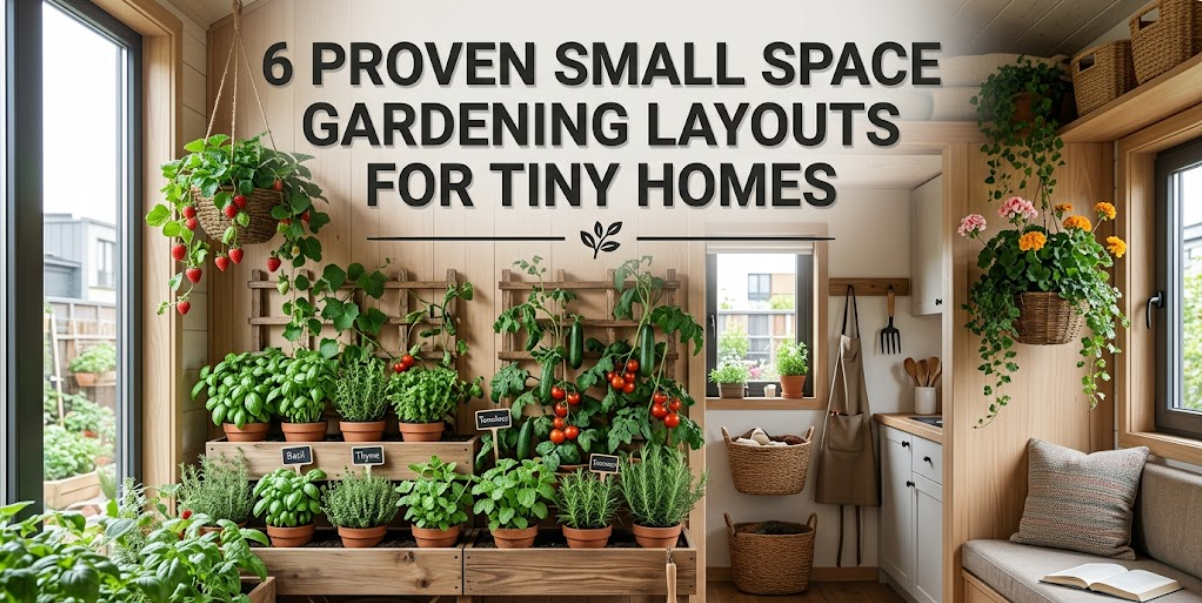
Small space gardening is not about how much room you have—it’s about how intelligently you use what’s available. Tiny homes, studio apartments, compact balconies, and even narrow patios can support surprisingly productive green spaces when the layout is designed with intention rather than improvisation.
Most gardening failures in small homes come from one core issue: random placement. Pots are added wherever space is found, not where they function best. Over time, this creates overcrowding, uneven light exposure, poor airflow, and inconsistent watering patterns.
A well-planned layout changes everything. Instead of forcing plants to survive in limited space, you design systems where plants naturally thrive within constraints.
Below are six proven small space gardening layouts that consistently deliver strong growth, better organization, and visually appealing results in tiny homes.
layout 1: vertical wall grid garden system
One of the most efficient ways to maximize small space gardening is to shift growth upward instead of outward. The vertical wall grid system transforms unused wall space into a structured growing surface.
This layout uses mounted panels, trellises, or modular grids where containers or pockets are attached in rows.
how it works:
Plants are arranged vertically in layers, with sunlight exposure determining placement.
vertical wall grid structure
| Height Level | Light Exposure | Suitable Plants |
|---|---|---|
| Top rows | full sun | tomatoes, peppers |
| Middle rows | moderate sun | herbs, lettuce |
| Lower rows | indirect light | mint, parsley, ferns |
why this layout works:
- maximizes unused vertical wall space
- improves airflow between plants
- creates organized watering zones
- reduces ground clutter completely
In tiny homes, this layout often replaces traditional garden beds entirely. It also improves aesthetics, turning plain walls into living green panels.
A major advantage is accessibility. Herbs and leafy greens can be harvested at eye level without bending or moving pots.
layout 2: L-shaped corner maximization system
Corners are often the most underutilized areas in small homes. The L-shaped gardening layout turns these overlooked zones into high-efficiency growing hubs.
This system uses two adjoining walls or floor corners to create a layered planting triangle.
corner layout design logic:
- tallest plants go at the back corner
- medium plants along side edges
- small or trailing plants at the front
corner layout chart
| Position | Plant Type | Function |
|---|---|---|
| Back corner | climbing plants | vertical expansion |
| Side edges | medium herbs | balanced growth |
| Front base | small greens | easy access |
why it works:
Corners naturally trap light and heat. This microclimate helps plants grow faster compared to open flat areas.
Additionally, the L-shape allows natural segmentation. You can dedicate one corner to herbs and the other to vegetables, creating mini-garden zones in a single compact area.
layout 3: tiered shelving garden system
Tiered shelving is one of the most practical and beginner-friendly small space gardening layouts. It uses stacked horizontal levels to create multiple planting surfaces within the same footprint.
Unlike vertical wall systems, this layout remains freestanding and portable.
tiered system structure
| Shelf Level | Light Level | Plant Recommendation |
|---|---|---|
| Top shelf | high sunlight | tomatoes, basil |
| Middle | partial sunlight | coriander, spinach |
| Bottom | low light | mint, ferns |
why this layout is effective:
- increases planting area without expanding floor space
- allows easy rotation of plants between levels
- simplifies watering and maintenance
- supports both decorative and edible plants
One hidden advantage is microclimate control. Upper shelves block heat and light for lower plants, creating natural shading systems.
This layout works especially well in kitchens, balconies, and compact indoor gardening setups.
layout 4: window sill micro herb station
Windows are often overlooked as gardening assets. The window sill micro garden converts this narrow space into a productive herb-growing station.
This layout is ideal for kitchens and small apartments where floor space is limited.
how it is structured:
Small pots or containers are aligned along the window sill in direct sunlight.
window sill usage table
| Window Type | Sun Exposure | Ideal Plants |
|---|---|---|
| South-facing | strong sunlight | basil, thyme |
| East-facing | morning sunlight | parsley, mint |
| West-facing | afternoon sun | chili, coriander |
why this layout works:
- uses existing architectural light sources
- reduces need for artificial lighting
- provides easy access for cooking herbs
- requires minimal setup and maintenance
The key limitation is space, but this is also its strength—it forces selection of only the most useful and frequently used herbs.
layout 5: hanging + railing hybrid system
This layout combines two high-efficiency methods: hanging containers and railing-mounted planters. It is especially effective in balconies and small outdoor extensions.
Instead of placing plants on the floor, containers are suspended or attached at different heights.
hybrid system structure
| Position | Container Type | Plant Type |
|---|---|---|
| Ceiling hooks | hanging pots | trailing plants |
| Railings | clamp planters | herbs, greens |
| Floor edges | heavy containers | root vegetables |
why this system works:
- frees up floor space completely
- improves air circulation around plants
- creates layered visual depth
- allows flexible rearrangement
A major advantage is mobility. Hanging pots can be adjusted based on sunlight changes throughout the day or season.
This layout also reduces pest problems because elevated plants are less accessible to soil insects.
layout 6: modular movable container grid system
The modular container grid is the most flexible small space gardening layout. It uses uniform pots or boxes arranged in a structured grid that can be rearranged at any time.
Instead of fixed positions, everything is mobile.
modular system layout
| Grid Zone | Plant Type | Purpose |
|---|---|---|
| Zone A | fast growers | quick harvest |
| Zone B | slow growers | long-term yield |
| Zone C | herbs | daily use |
why it works:
- allows seasonal reconfiguration
- makes cleaning and pest control easier
- supports experimentation with crops
- adapts to changing sunlight patterns
This system is especially useful for beginners because it does not require permanent installation. You can continuously adjust based on plant performance.
It also works well for renters who cannot modify walls or floors.
comparison of all six layouts
layout performance overview
| Layout Type | Space Efficiency | Maintenance Level | Flexibility | Best For |
|---|---|---|---|---|
| Vertical wall grid | very high | medium | medium | balconies, walls |
| L-shaped corner system | high | low | medium | small rooms |
| Tiered shelving system | high | low | high | indoor/outdoor mix |
| Window sill station | medium | very low | low | kitchens |
| Hanging hybrid system | very high | medium | high | balconies |
| Modular container grid | high | low | very high | flexible spaces |
Each layout solves a different spatial challenge. The key is not choosing one—but combining two or more depending on your home structure.
how to choose the right layout for your space
Instead of guessing, use a simple decision logic:
space selection guide
| Home Type | Recommended Layout Combination |
|---|---|
| tiny apartment | window + tiered system |
| balcony only | vertical + hanging hybrid |
| corner room | L-shape + modular grid |
| kitchen space | window + small modular system |
| rented home | modular + tiered shelving |
Combining layouts allows maximum utilization without overcrowding any single area.
common mistakes in small space gardening layouts
Even well-designed layouts fail if basic principles are ignored. Some frequent mistakes include:
- overcrowding containers in one zone
- ignoring weight limits on shelves or balconies
- mixing plants with incompatible sunlight needs
- using decorative pots without drainage
- failing to rotate plants seasonally
Small spaces amplify mistakes. A single poorly placed plant can affect airflow, light, and moisture balance across the entire system.
optimization principles for all layouts
Regardless of layout type, five universal principles improve results:
- light first: always prioritize sunlight access
- airflow second: avoid dense clustering
- drainage third: never trap water
- accessibility fourth: ensure easy harvesting
- adaptability fifth: allow rearrangement
When these principles are followed, even basic layouts perform significantly better.
quick reference summary chart
| Principle | Why it matters | Impact level |
|---|---|---|
| Light | drives growth | very high |
| Airflow | prevents disease | high |
| Drainage | avoids root rot | very high |
| Accessibility | improves maintenance consistency | medium |
| Flexibility | supports seasonal change | high |
faqs
- what is the best small space gardening layout for beginners
The tiered shelving system is easiest because it requires no wall installation and allows simple plant organization. - can I combine multiple layouts in one small space
Yes. In fact, combining layouts like vertical + modular often produces the best results in tiny homes. - how do I know if my space gets enough sunlight
Observe your space throughout the day. Most edible plants need at least 4–6 hours of direct or strong indirect light. - what plants work best in small space gardens
Herbs like basil, mint, coriander, and fast-growing greens like spinach perform best in compact systems. - how often should I rearrange my garden layout
Seasonal adjustments every 2–3 months help maintain optimal growth conditions. - do small space gardens require expensive equipment
No. Most successful systems use simple shelves, recycled containers, and basic soil mixes.
Small space gardening is not limited by size—it is shaped by structure. When layout replaces randomness, even the smallest home can support a productive, organized, and visually rich green environment.