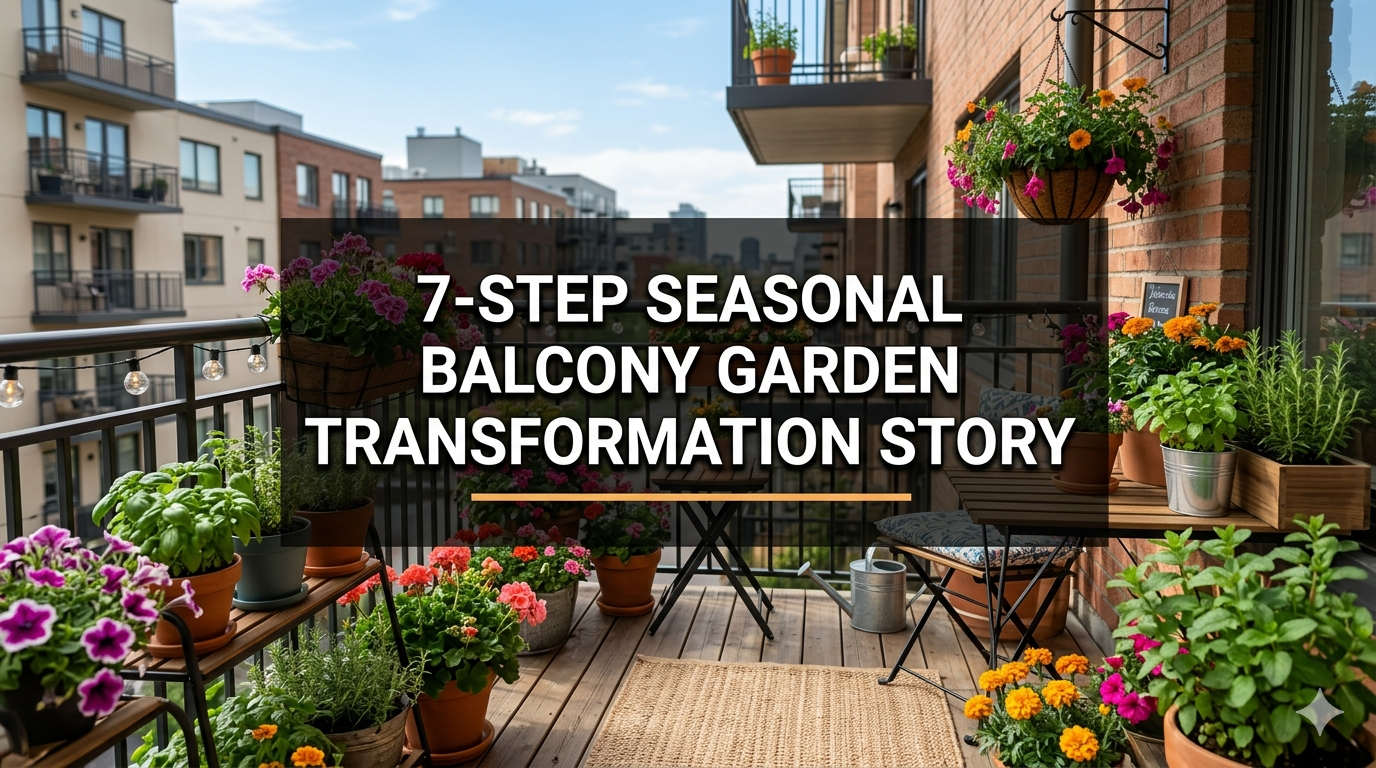
When I first started paying attention to my balcony, it didn’t feel like a garden at all. It felt like wasted square footage. A couple of empty pots, some dusty corners, and sunlight that came in too harsh or not at all depending on the season.
What changed everything for me wasn’t buying expensive plants or tools. It was learning how the same space behaves differently across seasons—and adjusting instead of resisting.
This is the story of how my balcony transformed through seven seasonal steps. Not in theory, but through trial, failure, and slow improvement over time.
step 1: understanding the balcony as a seasonal space
My first mistake was treating my balcony like a fixed environment. I assumed that once I placed a plant somewhere, it should just “work.”
But small outdoor spaces don’t stay the same. Summer heat, winter chill, monsoon humidity—they all reshape how light, soil, and airflow behave.
Once I started tracking these changes, I realized my balcony was actually four different gardens in a year.
season behavior overview table
| season | light intensity | watering need | plant performance |
|---|---|---|---|
| spring | balanced | moderate | strong growth |
| summer | harsh/high | frequent | stress risk |
| monsoon | low + humid | low | fungus risk |
| winter | soft/low | minimal | slow growth |
That realization became the foundation of everything else.
step 2: spring reset — rebuilding the soil system
Spring was when I learned that gardening isn’t just planting—it’s preparation.
I used to simply reuse old soil from previous seasons. That led to weak growth and poor drainage. So in my first proper seasonal reset, I completely rebuilt my soil mix.
Instead of buying expensive mixes, I created my own:
- garden soil (base)
- compost (nutrients)
- coco peat (moisture balance)
- sand (drainage)
soil mix comparison chart
| mix type | water retention | nutrients | plant health outcome |
|---|---|---|---|
| reused soil | low | low | weak growth |
| store-bought mix | medium | medium | stable growth |
| custom blend | balanced | high | strong growth |
This step made everything that followed more stable.
Plants stopped struggling in the early stage because the foundation was no longer unpredictable.
step 3: summer survival — controlling heat instead of fighting it
Summer was where most of my plants used to fail.
The balcony would heat up like an oven by mid-day. Leaves would curl, soil would dry out in hours, and even watering twice a day sometimes wasn’t enough.
Instead of trying to “fix” summer, I started managing exposure.
I used:
- a light cotton sheet for shade
- repositioning pots away from direct sun
- grouping plants to reduce evaporation
summer stress control table
| problem | cause | solution used |
|---|---|---|
| leaf burn | direct sunlight | shade cloth |
| dry soil | fast evaporation | mulching |
| drooping plants | heat stress | relocation |
The biggest shift was accepting that summer isn’t a gardening-friendly season—it’s a management season.
step 4: monsoon adaptation — learning to prevent decay
Monsoon surprised me the most. I assumed more water would help plants grow faster. Instead, I saw mold, fungus, and root issues appearing everywhere.
The problem wasn’t rain—it was stagnation.
Water wasn’t draining fast enough, and airflow dropped dramatically.
So I adjusted three things:
- improved drainage holes in pots
- stopped overwatering completely
- increased spacing between plants
monsoon risk chart
| issue | trigger condition | prevention method |
|---|---|---|
| root rot | excess moisture | drainage improvement |
| fungus growth | humidity + crowding | spacing + airflow |
| leaf spotting | wet leaves | avoid overhead watering |
Once I adapted, monsoon stopped being destructive and became almost maintenance-free.
step 5: autumn transition — restoring balance
Autumn felt like a recovery season. Plants that struggled in summer started bouncing back naturally.
This was the first time I noticed something important: not all improvement comes from action. Some comes from timing.
Instead of making major changes, I focused on:
- light pruning
- soil aeration
- removing dead leaves
It was less about fixing and more about letting the garden stabilize itself.
season transition behavior chart
| action | intensity level | purpose |
|---|---|---|
| pruning | light | shape control |
| fertilizing | moderate | recovery boost |
| watering | balanced | stabilization |
Autumn taught me that sometimes the best gardening decision is to slow down.
step 6: winter slowdown — working with reduced growth
Winter completely changed my expectations.
At first, I thought something was wrong because everything looked slow. Plants weren’t dying—they were just resting.
Once I understood that, I adjusted my approach.
Instead of pushing growth, I focused on maintenance:
- watering less frequently
- avoiding fertilizer overload
- maximizing available sunlight
winter adjustment table
| factor | summer approach | winter approach |
|---|---|---|
| watering | frequent | minimal |
| fertilizing | regular | paused or reduced |
| growth target | fast | stable |
Winter became the season where I stopped interfering and simply maintained balance.
step 7: full-cycle optimization — connecting all seasons
After one full year, I stopped thinking in isolated seasons and started thinking in cycles.
Each season now had a role:
- spring builds
- summer protects
- monsoon tests
- autumn restores
- winter maintains
That perspective changed how I designed the entire balcony layout.
seasonal cycle system chart
| season | role in system | focus area |
|---|---|---|
| spring | growth foundation | soil + planting |
| summer | stress management | shade + hydration |
| monsoon | protection | drainage + airflow |
| autumn | recovery | pruning + balance |
| winter | maintenance | survival stability |
Instead of reacting every month, I started preparing in advance.
what the transformation really looked like over time
The most surprising part wasn’t how the garden looked at the end—it was how it changed my behavior.
I stopped overwatering. I stopped randomly moving plants. I stopped expecting constant growth.
Instead, I began observing patterns.
growth progression chart (real experience timeline)
| month | garden condition | key change |
|---|---|---|
| 1 | unstable setup | poor soil structure |
| 3 | partial survival | improved drainage |
| 6 | seasonal awareness | reduced plant loss |
| 9 | stable cycles | predictable growth |
| 12 | optimized system | balanced ecosystem |
By the end of the year, the balcony didn’t feel like a collection of pots anymore. It felt like a system that responded to time.
what this journey taught me
If I had to summarize everything, it would be this: a balcony garden doesn’t fail because of space. It fails because of timing mistakes.
Once I started respecting seasonal shifts instead of fighting them, everything became easier.
Plants didn’t suddenly become stronger. I just stopped working against their natural cycles.
faqs
- how do seasonal changes affect balcony gardening?
Seasonal changes impact sunlight, temperature, and humidity, which directly influence plant growth, watering needs, and survival rates. - what is the best season to start a balcony garden?
Spring is generally the best season because plants establish roots faster and grow more consistently. - how do I protect balcony plants in summer heat?
Use shade cloth, move pots away from direct sunlight, and increase watering frequency carefully without overwatering. - why do plants struggle during monsoon season?
Excess moisture, poor drainage, and low airflow can cause root rot and fungal infections. - should I fertilize plants in winter?
Usually no. Most plants slow down in winter and do not need heavy fertilization. - how long does it take to see a stable balcony garden system?
With consistent seasonal adjustments, most people see stability within 6–12 months.