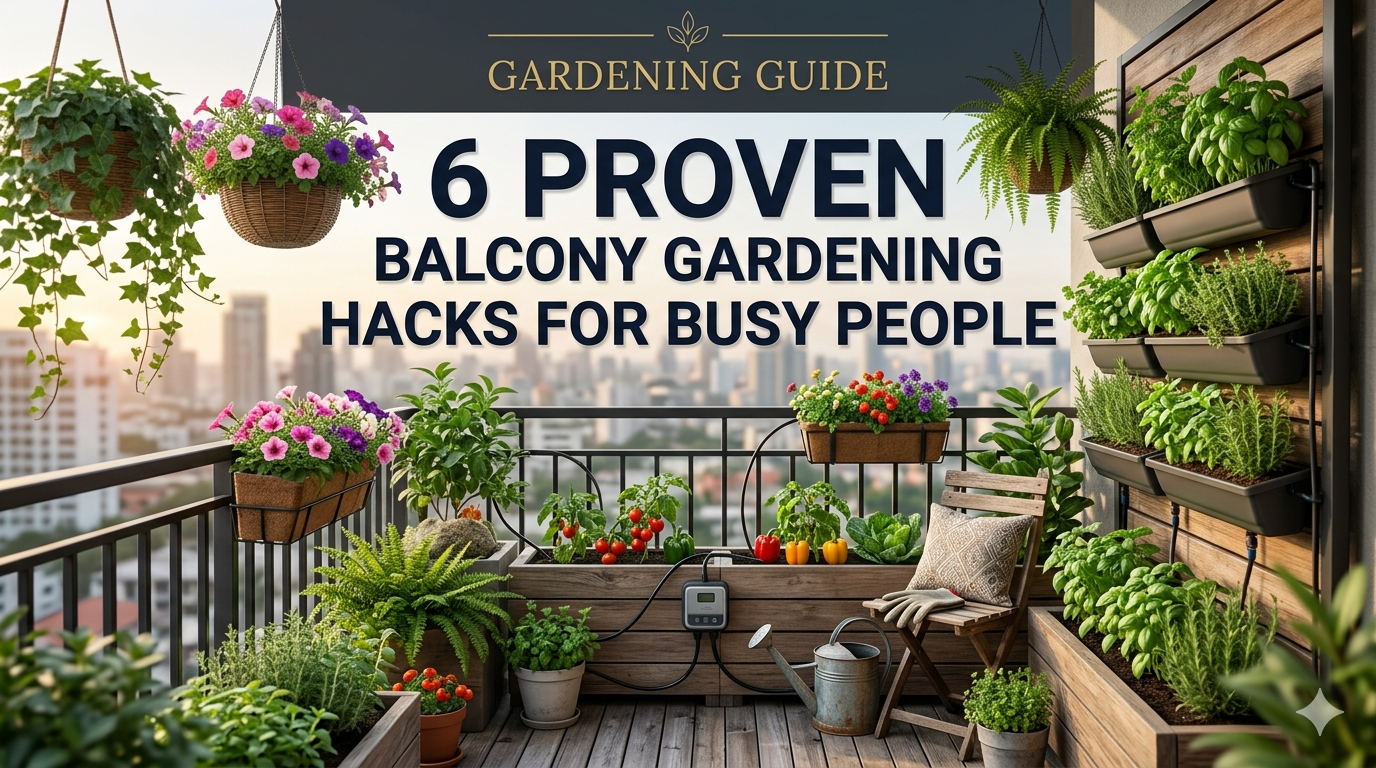
Balcony gardening often gets framed as a relaxing hobby, but for many people, it competes with tight schedules, unpredictable work hours, and everyday fatigue. The result is familiar: plants that start with enthusiasm slowly fade because care routines become inconsistent.
The truth is, balcony gardening doesn’t require constant attention. What it needs is structure—systems that reduce decision-making, prevent small problems from escalating, and keep plants stable even when life gets busy.
These six hacks are designed specifically for people who don’t have time for daily gardening but still want healthy, productive greenery in small balcony spaces.
hack 1: build a “set-and-forget” watering system
Watering is the most time-consuming and most frequently forgotten task in gardening. Busy people either overwater in bursts or forget entirely for days.
A low-maintenance watering system solves this problem by stabilizing moisture levels.
simple self-watering setup options:
- plastic bottle drip system
- wick-based containers
- shallow water tray method
- self-watering pots
watering system comparison table
| Method | Effort Level | Water Efficiency | Maintenance Frequency |
|---|---|---|---|
| manual watering | high | medium | daily |
| bottle drip system | low | medium-high | every 3–5 days |
| wick system | very low | high | weekly |
| self-watering pots | very low | very high | biweekly |
why this works:
Instead of reacting to dryness, the system maintains consistent moisture. Plants grow better under stability than under irregular attention.
A hidden advantage is reduced stress. You no longer need to “remember” watering—it happens passively.
hack 2: choose plants that survive neglect, not perfection
Busy gardeners often fail because they choose high-maintenance plants. Instead, success comes from selecting resilient species that tolerate inconsistency.
best low-maintenance balcony plants
| Plant Type | Care Level | Growth Speed | Survival Ability |
|---|---|---|---|
| mint | very low | fast | extremely high |
| basil | low | fast | high |
| spinach | low | fast | high |
| aloe vera | very low | slow | extremely high |
| chili pepper | medium | medium | high |
why this works:
These plants recover quickly from missed watering or delayed care. They also require minimal pruning or intervention.
The goal is not maximum variety—it’s reliability. A small group of dependable plants outperforms a large collection of fragile ones.
hack 3: use container grouping instead of scattered pots
One major time drain in balcony gardening is scattered maintenance. When plants are placed randomly, watering, pruning, and checking becomes inefficient.
Grouping containers simplifies everything.
grouping structure:
- cluster 1: herbs
- cluster 2: vegetables
- cluster 3: decorative plants
container grouping chart
| Group Type | Function | Maintenance Benefit |
|---|---|---|
| herb cluster | daily use | quick harvesting |
| veggie cluster | growth focus | scheduled care |
| decor cluster | visual balance | low maintenance |
why this works:
Instead of moving across the balcony multiple times, all tasks are completed zone by zone.
It reduces mental load as much as physical effort. You know exactly where everything is.
hack 4: automate sunlight management with fixed placement rules
Busy people rarely have time to shift plants based on sunlight changes. A fixed placement system removes this requirement.
Instead of rotating plants daily or weekly, assign permanent sunlight roles.
sunlight zoning table
| Balcony Zone | Sun Exposure | Plant Type |
|---|---|---|
| edge zone | full sun | tomatoes, chili |
| middle zone | partial sun | basil, spinach |
| inner zone | low light | mint, ferns |
why this works:
Plants adapt to consistent light patterns. Constant repositioning actually creates more stress than benefit.
By locking plants into stable zones, maintenance becomes passive instead of active.
hack 5: reduce maintenance frequency using soil optimization
Busy gardeners often think they need to do more care. In reality, better soil reduces the need for frequent intervention.
A strong soil mix holds moisture, releases nutrients slowly, and reduces dependency on constant fertilization.
low-maintenance soil mix:
- coco coir (moisture retention)
- compost (nutrients)
- perlite (air flow)
- vermicompost (slow feeding)
soil performance chart
| Soil Type | Water Retention | Fertilizer Need | Maintenance Load |
|---|---|---|---|
| basic garden soil | low | high | high |
| standard potting mix | medium | medium | medium |
| optimized mix | high | low | low |
why this works:
Good soil acts like a slow-release system. Instead of reacting to problems, plants are continuously supported.
This alone can reduce gardening effort by more than 50%.
hack 6: use a “weekly 10-minute maintenance loop”
Instead of daily attention, busy people benefit from structured weekly care sessions.
The idea is simple: one short, focused routine replaces scattered daily effort.
weekly 10-minute checklist:
- check soil moisture
- remove dry leaves
- inspect pests
- rotate one or two plants (if needed)
- harvest usable herbs
maintenance efficiency table
| Routine Type | Time Required | Effectiveness | Stress Level |
|---|---|---|---|
| daily micro-care | 5–10 min/day | inconsistent | high |
| weekly batch care | 10–15 min | consistent | low |
| irregular care | random | poor | very high |
why this works:
Batch processing is more efficient than scattered tasks. It also builds a predictable rhythm that fits into busy lifestyles.
The key is consistency, not frequency.
combining all six hacks into a busy-friendly system
Each hack solves a different problem, but together they create a self-sustaining balcony garden system that requires minimal attention.
system overview
| Area | Hack Used | Outcome |
|---|---|---|
| watering | self-watering system | stable moisture |
| plant selection | resilient crops | low failure rate |
| organization | grouped containers | faster maintenance |
| sunlight | fixed zoning | predictable growth |
| soil health | optimized mix | reduced feeding needs |
| maintenance | weekly loop | time efficiency |
When combined, these systems shift gardening from a daily chore into a weekly check-in activity.
common mistakes busy gardeners make
Even with good intentions, several habits reduce success:
- trying to grow too many plant varieties
- changing plant positions too frequently
- relying on memory instead of structure
- using inconsistent watering methods
- skipping soil improvement
- reacting instead of planning
These mistakes create extra workload, which defeats the purpose of a low-maintenance system.
why busy people fail at gardening (and how this fixes it)
Most gardening advice assumes time availability. But busy people don’t fail because they lack interest—they fail because systems are not designed for low attention.
These hacks work because they:
- reduce daily decisions
- eliminate repetitive tasks
- stabilize plant conditions
- convert effort into systems
Once systems are in place, plants no longer depend on constant human input.
quick reference efficiency chart
| Hack | Time Saved | Impact Level | Ease of Setup |
|---|---|---|---|
| watering automation | high | very high | easy |
| resilient plant choice | medium | high | very easy |
| container grouping | high | medium | easy |
| sunlight zoning | medium | high | very easy |
| soil optimization | high | very high | moderate |
| weekly care loop | very high | high | very easy |
faqs
- can I really maintain a balcony garden with very little time
Yes. With the right systems, 10–15 minutes per week is often enough for maintenance. - what is the easiest plant for busy people
Mint is one of the easiest because it grows aggressively and tolerates neglect well. - do self-watering systems really work
Yes. They maintain consistent moisture, which is more effective than irregular manual watering. - how many plants should a busy person start with
Start with 3–6 plants. Small numbers are easier to manage and more stable. - what is the biggest mistake in low-maintenance gardening
Trying to grow too many different plants at once instead of focusing on reliable ones. - can I automate everything in balcony gardening
Not fully, but you can automate most watering and reduce maintenance to weekly checks.
Balcony gardening for busy people is not about doing less care randomly—it’s about designing systems that remove the need for constant attention. When structure replaces memory, and consistency replaces effort, even a small balcony can stay green, productive, and surprisingly low-maintenance throughout the year.