
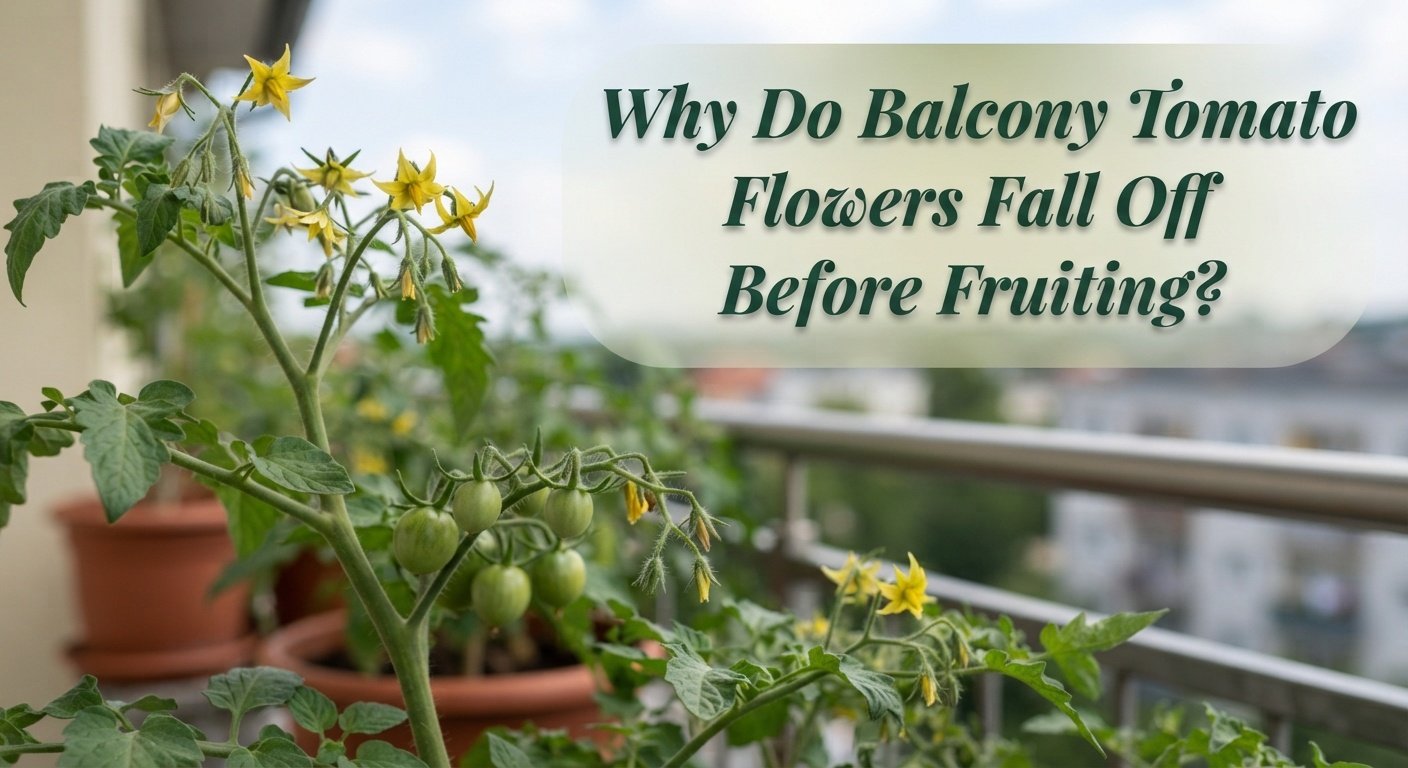
A reader once sent me a photo of her cherry tomato plant. Dozens of yellow flowers, not one fruit, and a small pile of dropped blossoms sitting in the saucer under the pot like confetti after a party nobody attended. Her question was simple. Is the plant sick?
It almost never is. Flower drop on balcony tomatoes is one of the most common complaints in small-space growing, and the causes are usually mechanical or environmental rather than anything wrong with the plant’s health.
1. No Wind Means No Pollination
Tomatoes are self-pollinating, which sounds like it should make things easy. It does, but only if pollen actually moves from the flower’s anthers to its stigma, and that movement depends almost entirely on vibration. Outdoors in open ground, wind and visiting bees do this constantly without anyone noticing. On a balcony, especially one tucked between buildings or shielded by a railing, there often isn’t enough air movement to shake the flowers at all.
This is the single most common reason for total fruit failure despite healthy-looking flowers. The plant blooms, nothing pollinates the bloom, and after a few days the flower yellows and drops because there’s no fertilized ovary to hold onto it. If you’re unsure whether your space gets enough airflow to begin with, it’s worth checking whether your balcony is too windy or, more often, not windy enough, since both extremes cause problems, just different ones.
The fix is almost embarrassingly simple. Flick each flower cluster gently with a finger, or run an electric toothbrush against the stem just below the flower for a second or two, once a day around midday when pollen is driest and most viable. It looks silly. It works.
2. Temperature Swings Confuse the Flower Before It’s Even Open
Tomato flowers are picky about temperature in a way that surprises a lot of new growers. Pollen becomes less viable once nighttime temperatures drop below about 55°F (13°C) or daytime temperatures push past roughly 90°F (32°C) for extended stretches. Balconies are prone to both extremes depending on orientation and season, and a south-facing balcony in particular can swing wildly between a cool morning and a scorching early afternoon.
Here’s where people usually go wrong. They assume flower drop in summer means too much heat, so they move the plant into more shade, which then reduces overall vigor and doesn’t address the actual pollen viability issue at all. The better fix is timing, not location. Hand-pollinate earlier in the day before peak heat sets in, and if your balcony runs unusually hot, understanding why balconies run hotter than a backyard will tell you whether the real problem is air temperature or radiant heat bouncing off nearby surfaces, because the second one is often the bigger culprit and it’s fixable with placement changes alone.
3. Inconsistent Watering Stresses the Plant at Exactly the Wrong Moment
A tomato plant under water stress, whether from too little or an erratic swing between soggy and bone dry, will drop flowers as a survival response. The plant is essentially deciding it doesn’t have the resources to support fruit development and cutting its losses at the bud stage. This shows up constantly in container growing because pots dry out faster and less predictably than garden beds, and a single missed watering day during a hot stretch can trigger noticeable flower loss within 48 hours.
Quick comparison: watering patterns and their typical effect on flowering
| Watering pattern | Effect on flowers |
|---|---|
| Consistent moisture, slight dry-out between waterings | Best outcome, minimal drop |
| Frequent light sips, soil never fully dries | Weak root development, moderate drop over time |
| Alternating soggy and bone-dry | Highest flower drop, stress response triggered repeatedly |
| Chronic underwatering | Severe drop, plant may stop flowering entirely |
If your watering routine feels like it’s always a step behind what the plant needs, the deeper issue might be pot size rather than habit. Small containers simply can’t buffer against heat and evaporation the way larger ones do, and I’ve watched more than one grower switch pots and solve a flowering problem they’d been chasing all season with nothing but a bigger container and the same watering schedule.
4. Too Much Nitrogen, Not Enough Everything Else
This one catches people who are doing something that sounds responsible. Feeding regularly with a general all-purpose fertilizer heavy in nitrogen. Nitrogen pushes leafy green growth, which looks great and makes the plant look thriving, but it does so at the expense of flowering and fruit set. A tomato plant that’s putting all its energy into new leaves has less to spare for holding onto blossoms, and you’ll often see this paired with a plant that looks lush and dark green but is stubbornly unproductive.
Switching to a fertilizer formulated for flowering and fruiting, typically higher in phosphorus and potassium relative to nitrogen, usually resolves this within a couple of weeks. It won’t happen overnight, since the plant needs to shift its own internal priorities, but the change is noticeable once it kicks in.
5. The Variety Itself Might Be a Poor Fit for Containers
Sometimes the plant isn’t doing anything wrong. It’s just the wrong plant for the space. Large indeterminate varieties bred for open garden rows can struggle in containers regardless of care, simply because the root system never gets enough volume to support the kind of flowering the variety was bred to produce. Determinate and dwarf varieties, bred specifically with compact growth in mind, tend to set fruit far more reliably in pots.
Before committing a whole season to a variety that keeps disappointing, it’s worth running it through a proper trial rather than assuming it’ll improve with more attention. I generally recommend testing any new plant before giving it a permanent spot on a small balcony, and tomatoes are one of the clearest examples of why that matters, because the variety on the seed packet often tells you more about eventual success than anything you do after planting it.
FAQs
How many flowers should actually turn into fruit on a healthy plant? Not all of them, and that’s normal. Even in ideal conditions, a tomato plant naturally drops a percentage of its flowers as it self-regulates fruit load. Seeing occasional drop isn’t a red flag on its own. It’s only concerning when the drop rate is consistently high across most clusters.
Can I hand-pollinate too much or damage the flower by touching it? It’s very hard to overdo this. Tomato flowers are sturdy, and gentle vibration or a light finger flick won’t cause damage. What can hurt outcomes is rough handling that snaps the stem or knocks the whole cluster off, so aim for a light touch rather than a firm shake.
Does balcony orientation matter for this specific problem? Yes, quite a bit. South and west-facing balconies tend to run hotter and can push pollen past its viable temperature range in peak summer, while north-facing setups sometimes struggle with insufficient light for strong flowering in the first place. How balcony orientation changes growing conditions is worth reading if you’re troubleshooting a specific spot.
I’ve fixed watering and pollination and I’m still getting drop. What else could it be? Check root space. A tomato that’s been in the same small pot for months, even with perfect watering and hand-pollination, may simply be root-bound and unable to support fruiting. Sizing up the container is often the missing piece once the more obvious causes have been ruled out.
Is it worth bothering with tomatoes on a small balcony at all if this keeps happening? Absolutely, once the actual cause is identified rather than guessed at. Most flower drop issues on small balcony garden setups trace back to one or two fixable factors, usually pollination and watering consistency, and growers who address those specifically tend to see a real turnaround within a single growing cycle.
Flower drop feels discouraging because it happens right at the point where a plant seems to be doing everything right. It’s rarely the plant’s fault in the way it looks. Most of the time it’s a small mismatch between what the space provides and what the flower needs at that exact moment, and once you know which mismatch you’re dealing with, the fix tends to be straightforward rather than mysterious.
For more on tomato flower and fruit set physiology, the University of Florida IFAS Extension has a detailed technical breakdown worth reading if you want the research behind it.