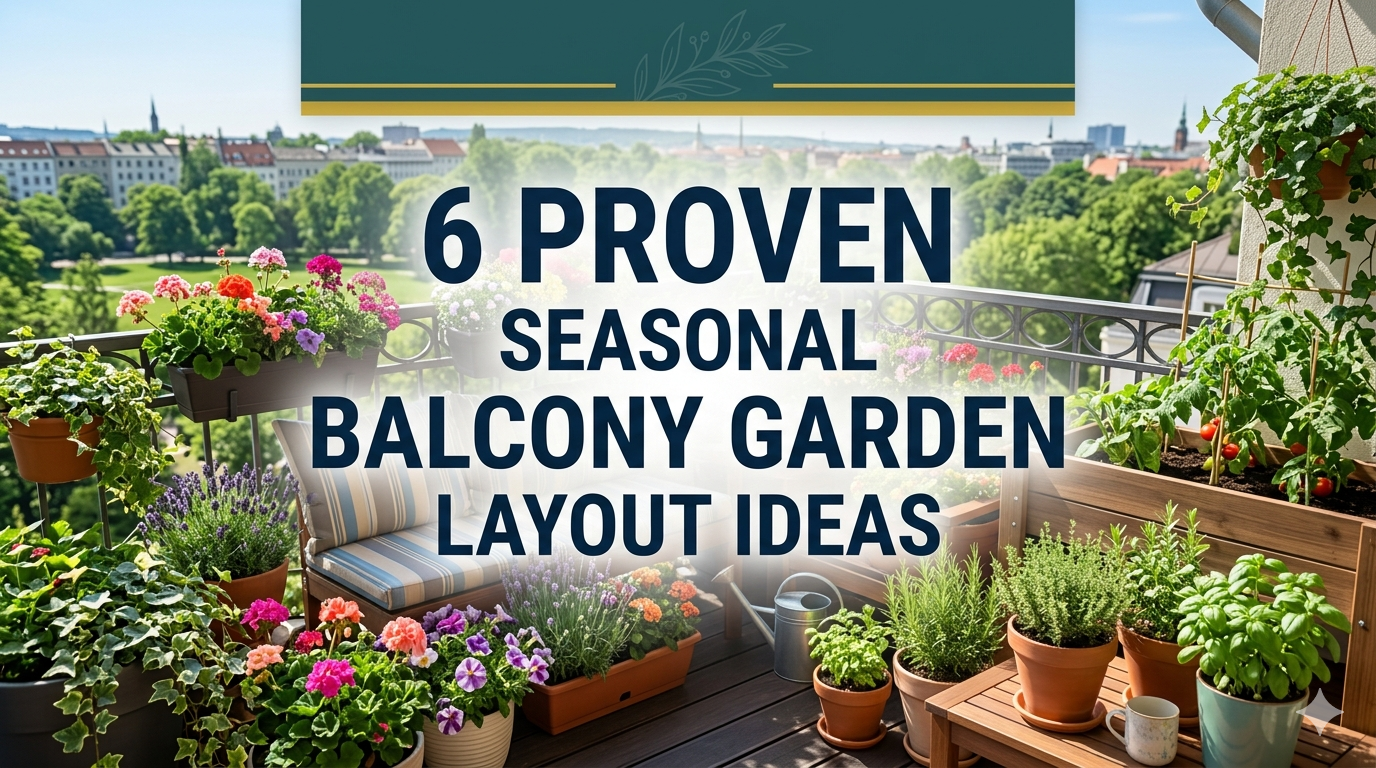
Balcony gardening changes dramatically with the seasons. What thrives in winter may struggle in summer. What grows slowly in spring can explode in monsoon humidity. Yet most balcony gardeners use a single fixed layout all year round, expecting plants to adapt to shifting conditions on their own.
That’s where problems begin: scorched leaves in summer, fungal growth in monsoon, and stunted growth in winter. The solution isn’t just better care—it’s seasonal layout planning.
A seasonal balcony garden layout means adjusting plant placement, grouping, and structure based on temperature, sunlight intensity, humidity, and airflow changes throughout the year.
Below are six proven seasonal balcony garden layout ideas that help plants not just survive—but perform at their best year-round.
layout 1: summer heat-shield layered layout
Summer is the most stressful season for balcony gardens. Direct sunlight becomes harsher, containers heat up quickly, and water evaporates faster than roots can absorb it.
The summer layout focuses on one goal: heat protection and shade management.
structure of summer layout:
Plants are arranged in layers where taller plants shield smaller ones from direct sun exposure.
summer layering chart
| Layer Position | Function | Plant Examples |
|---|---|---|
| Outer edge | heat barrier | sunflower, okra |
| Middle layer | partial shade zone | chili, basil |
| Inner zone | protected growth | spinach, coriander |
key design principles:
- tall plants face west or south sun exposure
- shade-loving plants are placed behind larger foliage
- containers are grouped tightly to reduce soil overheating
- reflective surfaces are avoided to prevent heat amplification
why this works:
Plants create a natural shielding system. Instead of fighting sunlight, the layout redistributes it. This reduces leaf burn and keeps soil temperatures stable.
A hidden advantage is water efficiency. Shaded soil loses moisture slower, reducing watering frequency.
layout 2: monsoon drainage-focused floating layout
Monsoon season brings heavy rainfall, humidity, and fungal risks. The biggest threat is not lack of water—but excess water and poor drainage.
The monsoon layout prioritizes elevation and airflow.
structure:
All containers are slightly elevated using stands, bricks, or racks. Plants are spaced further apart than in other seasons.
monsoon layout structure
| Feature | Purpose | Effect |
|---|---|---|
| elevated pots | prevent waterlogging | root protection |
| wide spacing | improve airflow | reduce fungus |
| slanted trays | drain excess water | soil balance |
plant selection in monsoon:
| Plant Type | Recommended Crops | Reason |
|---|---|---|
| herbs | mint, lemongrass | humidity tolerant |
| leafy greens | lettuce, spinach | fast draining soil |
| avoid | tomatoes, succulents | rot-prone |
why this works:
Air circulation becomes the main defense mechanism. Instead of fighting humidity, the layout allows it to pass through without stagnation.
Spacing is more important than density in this season.
layout 3: winter sunlight-maximization layout
Winter balconies often suffer from reduced sunlight hours and lower temperatures. The goal shifts from protection to heat absorption and light concentration.
This layout focuses on capturing every bit of available sunlight.
structure:
Plants are arranged in a sun-facing gradient, with reflective surfaces subtly enhancing light exposure.
winter sunlight layout chart
| Position | Sun Exposure Focus | Suitable Plants |
|---|---|---|
| front edge | full sun capture | peas, carrots |
| middle zone | moderate light | spinach, coriander |
| back wall | heat retention | herbs, garlic greens |
design strategies:
- use light-colored walls or boards to reflect sunlight
- place containers closer together to retain warmth
- avoid excessive shading plants
- use dark pots to absorb heat
why this works:
Plants rely on maximizing limited sunlight. Heat retention becomes critical, especially during colder nights.
This layout often results in slower but more stable growth, which is ideal for winter crops.
layout 4: spring regeneration modular layout
Spring is a transition season. Plants begin recovering from winter stress, and growth accelerates naturally. This is the best time for restructuring the garden.
The spring layout is modular and flexible, allowing frequent rearrangement.
structure:
Containers are grouped into rotating clusters based on growth speed.
spring modular system
| Cluster Type | Plant Category | Purpose |
|---|---|---|
| fast cluster | herbs, greens | quick harvest |
| medium cluster | vegetables | steady growth |
| slow cluster | perennials | long-term stability |
key features:
- containers are mobile and rearrangeable
- plants are grouped by growth rate
- frequent pruning and replanting is encouraged
why this works:
Spring growth is unpredictable. A flexible layout allows adaptation without redesigning the entire balcony.
It also supports continuous harvesting cycles.
layout 5: transitional shade-balanced layout (pre-summer & post-monsoon)
Certain periods in the year are unstable—especially when seasons shift. This layout is designed for transition phases where weather is inconsistent.
The goal is balance: neither too much sun nor too much moisture.
structure:
Plants are evenly distributed with partial shading zones created using lightweight covers or taller companion plants.
transitional balance chart
| Zone Type | Conditions | Plant Types |
|---|---|---|
| balanced zone | mixed sunlight | basil, spinach |
| shaded zone | reduced sun | mint, parsley |
| exposed zone | direct light | chili, tomatoes |
design features:
- temporary shading cloths are used
- plant grouping is symmetrical
- airflow remains open but controlled
why this works:
Transition periods often cause the most plant stress. This layout reduces sudden environmental shocks by stabilizing exposure levels.
It acts like a buffer system between extreme seasonal layouts.
layout 6: year-round hybrid rotation layout
The most advanced system is a hybrid rotational layout that adapts continuously throughout the year instead of switching entirely between seasons.
It combines all seasonal principles into a flexible system.
structure:
The balcony is divided into permanent zones that rotate function based on season.
year-round rotation table
| Zone | Summer Use | Winter Use | Monsoon Use |
|---|---|---|---|
| Zone A | shade crops | sun crops | drainage crops |
| Zone B | heat-tolerant | herbs | humidity plants |
| Zone C | protected zone | reflective zone | elevated zone |
key advantages:
- no complete redesign needed
- plants rotate instead of being replaced
- long-term soil health improves
- space is used efficiently year-round
why this works:
Instead of treating seasons as separate systems, this layout treats the balcony as a dynamic environment. Plants move through roles rather than being static.
It is the closest approach to a “self-adjusting garden system” in small spaces.
seasonal comparison overview
seasonal performance matrix
| Layout Type | Summer | Monsoon | Winter | Flexibility |
|---|---|---|---|---|
| heat-shield layering | high | medium | low | medium |
| drainage floating system | medium | high | low | low |
| sunlight maximization | low | medium | high | low |
| spring modular system | medium | medium | medium | high |
| transitional layout | high | medium | high | high |
| hybrid rotation system | high | high | high | very high |
common mistakes in seasonal balcony layouts
Even with good planning, several mistakes reduce effectiveness:
- keeping the same layout year-round
- ignoring airflow during monsoon season
- using reflective heat surfaces in summer
- overwatering in winter due to low evaporation
- failing to rotate plant types seasonally
- overcrowding containers during growth seasons
Small space gardens respond quickly to environmental imbalance, so minor errors have amplified effects.
principles behind successful seasonal layouts
All six layouts follow the same underlying principles:
- seasonal adaptation over static design
- airflow management as a priority
- water control based on climate, not habit
- light optimization rather than uniform exposure
- plant grouping based on behavior, not appearance
Once these principles are understood, layout changes become intuitive instead of complicated.
quick reference seasonal strategy table
| Season | Main Challenge | Primary Solution |
|---|---|---|
| Summer | heat stress | shading & layering |
| Monsoon | excess moisture | elevation & spacing |
| Winter | low sunlight | reflection & density |
| Spring | rapid growth | modular flexibility |
faqs
- how often should I change my balcony garden layout
Ideally 3–4 times a year, aligned with seasonal transitions. - can I use the same plants all year round
Some herbs like mint can survive year-round, but most vegetables perform better seasonally. - what is the most difficult season for balcony gardening
Monsoon is often the most challenging due to humidity and fungal risks. - do I need expensive equipment for seasonal layouts
No. Most layouts rely on simple containers, stands, and natural positioning. - how do I know when to switch layouts
Monitor temperature, sunlight duration, and rainfall patterns. Significant shifts indicate a layout change. - can small balconies still follow seasonal gardening layouts
Yes. Even very small spaces benefit from micro versions of these layouts using compact containers.
Seasonal balcony gardening is not about constant effort—it’s about intelligent adjustment. When layouts shift with the environment, plants stop struggling against conditions and start responding naturally to them. Over time, this creates a more stable, productive, and visually balanced green space that evolves throughout the year instead of fighting against it.