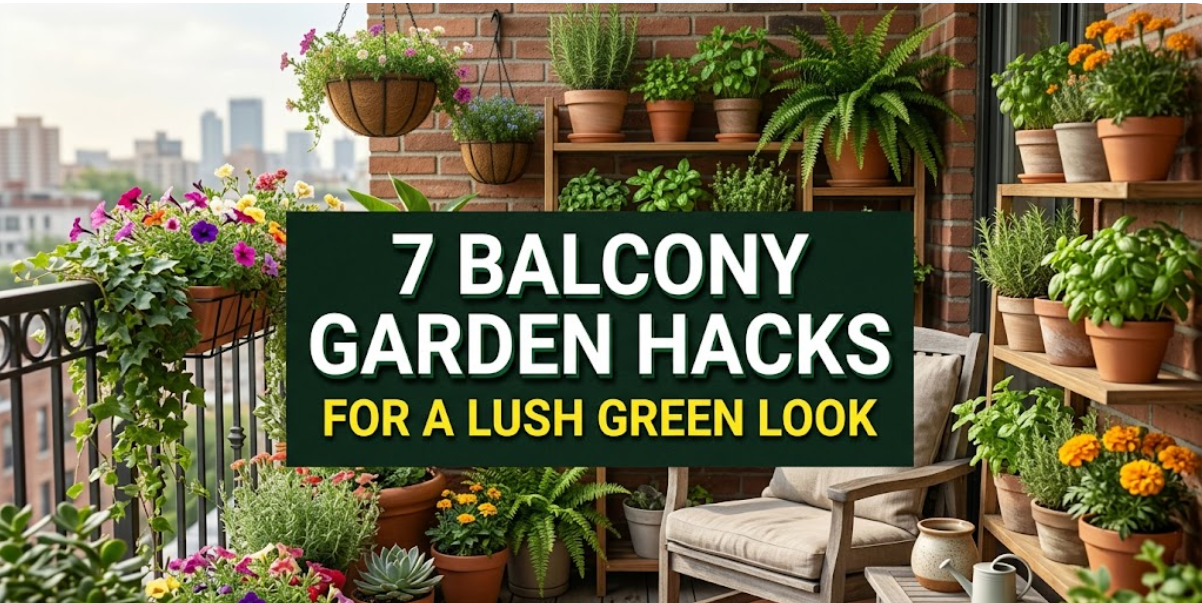
A lush, green balcony doesn’t require a big space, expensive tools, or professional gardening skills. What it does require is smart planning, a few clever tricks, and consistency in small actions. Even a tiny urban balcony can be transformed into a dense green escape that feels alive, refreshing, and visually rich.
The key idea behind a “lush look” is not just growing plants, but creating layers, depth, and density. Think of it like designing a miniature jungle where every plant plays a role in filling space, softening edges, and creating natural flow.
Below are seven practical balcony garden hacks that help you achieve that full, vibrant, and lush appearance—even if you’re short on time or experience.
hack 1: layer your plants like a mini forest
One of the biggest secrets to a lush balcony is vertical layering. Instead of placing all plants at one height, you build levels—just like nature does in forests.
A natural forest has:
- tall canopy trees
- mid-height shrubs
- ground-level plants
- trailing vines
You can replicate this on your balcony.
how to apply layering
- top layer: hanging pots or tall stands
- middle layer: medium-height leafy plants
- bottom layer: small pots or ground containers
- edge layer: trailing plants over railings
table: plant layering structure for balconies
| Layer Level | Plant Type Examples | Purpose in Design |
|---|---|---|
| Top Layer | Hanging pothos, ferns | Creates green canopy |
| Middle Layer | Basil, peace lily | Adds bulk and fullness |
| Bottom Layer | Succulents, herbs | Fills gaps and floor |
| Edge Layer | Money plant, ivy | Softens balcony edges |
visual impact tip
The more overlap between layers, the more “wild” and lush your balcony appears.
hack 2: go vertical to double your greenery
If floor space is limited, walls become your best friend. Vertical gardening allows you to multiply greenery without increasing clutter.
Instead of placing 5 pots on the ground, you can place 20 plants vertically.
popular vertical setups:
- wall-mounted planters
- railing planters
- ladder shelves
- hanging grid systems
chart: space usage comparison
| Setup Type | Plants per Sq Ft | Visual Density | Maintenance Ease |
|---|---|---|---|
| Floor pots only | Low | Low | Easy |
| Mixed setup | Medium | Medium | Medium |
| Vertical garden | High | Very high | Medium |
design insight
Vertical gardens naturally create a “green wall” effect, which is one of the fastest ways to achieve a lush aesthetic.
hack 3: use trailing plants for instant fullness
Trailing plants are one of the simplest ways to make a balcony look overgrown (in a good way). These plants naturally spill over edges, soften hard structures, and fill empty air space.
best trailing plants:
- money plant (pothos)
- ivy
- string of pearls
- creeping fig
- philodendron varieties
why trailing plants matter
They create movement. A balcony with only upright plants can feel structured but flat. Trailing plants add flow and depth.
table: trailing plant performance
| Plant Name | Growth Speed | Light Needs | Visual Effect |
|---|---|---|---|
| Money plant | Fast | Low–medium | Dense cascading look |
| Ivy | Medium | Medium | Wild, forest-like |
| Creeping fig | Medium | Medium–high | Wall coverage |
| Philodendron | Fast | Low–medium | Soft trailing vines |
pro tip
Place trailing plants at the highest point possible so gravity does the design work for you.
hack 4: group plants in clusters, not singles
One of the biggest mistakes in balcony gardening is spacing plants too far apart. While it may look organized, it prevents a lush effect.
Instead, group plants in clusters.
cluster method:
- group 3–5 plants together in one zone
- mix heights and textures
- repeat clusters across balcony
This creates visual density, which is key to a jungle-like feel.
chart: visual density comparison
| Arrangement Type | Plant Spacing | Visual Result |
|---|---|---|
| Single pots | Wide | Sparse |
| Mixed spacing | Medium | Balanced |
| Cluster grouping | Tight | Lush & dense |
design principle
Nature rarely spaces plants evenly. Mimicking randomness creates realism and fullness.
hack 5: mix leaf textures for visual richness
A lush balcony is not just about quantity—it’s about variety in texture.
If all your plants look similar, even a large collection won’t feel dense. But when you mix different leaf shapes, sizes, and shades, the space instantly feels richer.
leaf texture types:
- broad leaves (monstera, peace lily)
- thin leaves (ferns, grasses)
- patterned leaves (calathea)
- waxy leaves (succulents)
- trailing vines (pothos)
table: texture combination guide
| Texture Type | Effect on Look | Best Pairing Plants |
|---|---|---|
| Broad leaves | Bold, tropical | Ferns, vines |
| Thin leaves | Soft, airy | Monstera, philodendron |
| Patterned | Decorative accent | Green fillers |
| Waxy | Clean contrast | Any leafy plant |
visual strategy
A mix of 3–4 different textures is enough to make a balcony look professionally designed.
hack 6: use green-on-green layering (not just flowers)
Many beginners rely heavily on flowers for beauty. While flowers are attractive, they are temporary and require more maintenance.
A lush balcony relies more on foliage than flowers.
why green works better:
- stays consistent year-round
- requires less maintenance
- builds density faster
- looks more natural
recommended foliage plants:
- ferns
- money plant
- rubber plant
- areca palm
- snake plant
chart: foliage vs flowering plants
| Feature | Foliage Plants | Flowering Plants |
|---|---|---|
| Maintenance | Low | Medium–High |
| Longevity | High | Seasonal |
| Visual Density | High | Medium |
| Water Needs | Moderate | High |
design takeaway
A lush balcony is 70% green structure and 30% color accents.
hack 7: create depth using height variation
Flat arrangements make balconies look smaller and less vibrant. Height variation fixes this instantly.
how to create height layers:
- use plant stands
- hang pots at different levels
- stack shelves
- mix tall and short plants together
even small differences in height (10–20 cm) make a noticeable visual impact.
table: height design effect
| Height Variation | Visual Depth | Space Perception |
|---|---|---|
| None | Flat | Small |
| Medium | Balanced | Medium |
| High variation | Deep | Spacious & lush |
design insight
The eye naturally reads layered height as abundance, even if the number of plants is moderate.
putting it all together: lush balcony formula
A truly lush balcony isn’t random—it follows a simple formula:
lush look formula:
- vertical gardening (40%)
- layering (20%)
- trailing plants (15%)
- texture variety (15%)
- height variation (10%)
If you combine all five, even a small balcony can feel like a dense green retreat.
maintenance chart for busy people
| Task | Frequency | Time Required |
|---|---|---|
| Watering | 2–3x/week | 10–15 mins |
| Trimming leaves | Weekly | 10 mins |
| Rearranging pots | Monthly | 20 mins |
| Fertilizing | Biweekly | 10 mins |
common mistakes to avoid
- overcrowding without planning layers
- using only one plant type
- ignoring sunlight direction
- placing all plants at same height
- overwatering due to assumptions
faqs
- how long does it take to make a balcony look lush
With proper layering and plant selection, you can see noticeable fullness in 3–6 weeks depending on growth speed. - what is the easiest plant for a lush balcony look
Money plant is one of the best options because it grows fast, trails easily, and requires minimal care. - can a small balcony still look lush
Yes, vertical gardening and clustering techniques can make even very small spaces look dense and green. - do I need expensive pots or tools
No. Even recycled containers and basic shelves can create a lush effect if arranged properly. - how many plants do I need for a lush look
Typically 10–20 well-placed plants are enough for a small to medium balcony. - what is the most important factor for lush growth
Layering and plant density matter more than the number of plants you have.
final thought
A lush balcony is not about complexity—it’s about layering simple choices in a smart way. When plants are arranged with depth, variety, and flow, even a compact urban space can feel like a living green escape.