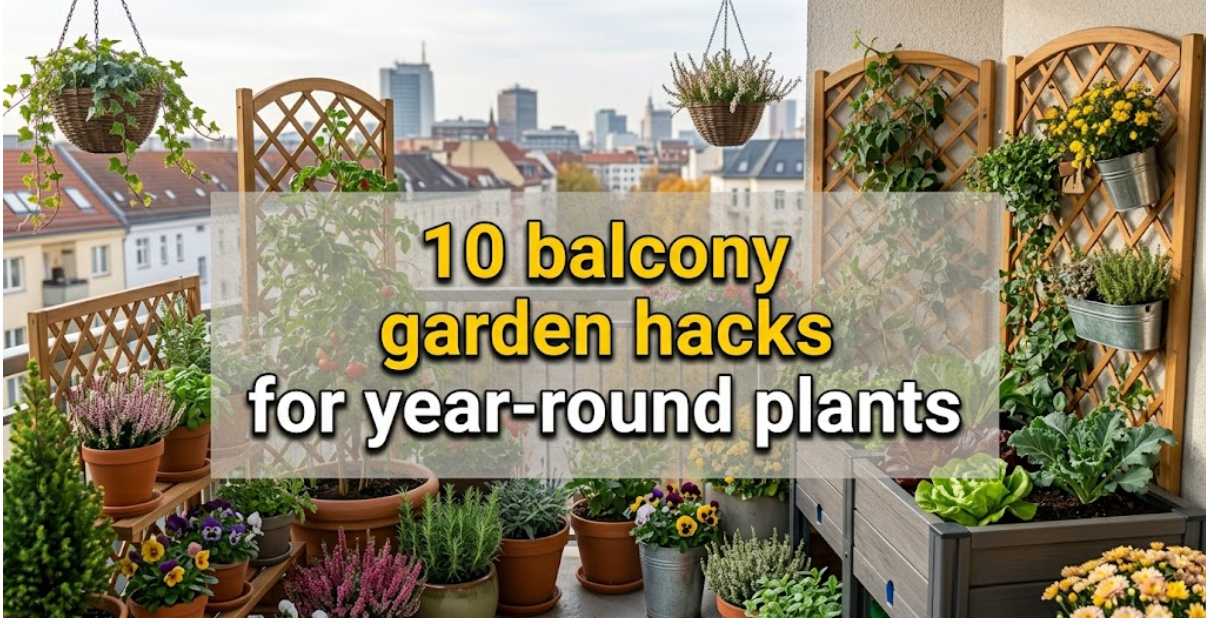
Balcony gardening is often treated like a seasonal hobby—something that works in spring and summer, then slowly fades when temperatures drop or conditions change. But with the right techniques, a balcony garden can stay productive, green, and healthy throughout the entire year.
The key is not just growing plants, but managing microclimates, soil systems, plant rotation, and environmental control in a small space. Unlike traditional gardens, a balcony is a controlled environment—you can actively shape it.
This guide breaks down 10 powerful balcony garden hacks that help you maintain year-round growth, even in changing weather conditions. Each section includes practical methods, tables, and real-world strategies you can apply immediately.
hack 1: design your balcony as a microclimate system
Most people think of a balcony as a small outdoor space. In reality, it behaves like a microclimate—a self-contained environment influenced by sun, wind, walls, and surrounding buildings.
If you understand this system, you can manipulate it for year-round growth.
Key microclimate factors:
- sunlight reflection from walls
- wind direction and intensity
- heat retention from flooring
- shade patterns across seasons
microclimate planning table
| Balcony Condition | Effect on Plants | Solution |
|---|---|---|
| Strong sun exposure | Fast drying soil | Use mulch + shade net |
| Heavy wind | Broken stems | Install wind barrier |
| Partial shade | Slow growth | Use shade-tolerant crops |
| Heat-retaining walls | Overheating roots | Use insulated pots |
By mapping your balcony’s behavior across a full day, you can assign plant zones: sun-loving plants in bright corners, shade plants near walls, and sensitive crops in protected areas.
hack 2: rotate crops every season instead of replacing them
Year-round gardening is not about planting once—it’s about continuous rotation.
Instead of letting your soil “rest unused,” replace crops strategically based on seasonal compatibility.
seasonal crop rotation guide
| Season | Best Crops | Growth Speed |
|---|---|---|
| Spring | Lettuce, peas, herbs | Fast |
| Summer | Tomatoes, peppers | Medium |
| Autumn | Spinach, kale | Fast |
| Winter | Microgreens, coriander | Very fast |
Rotating crops prevents soil fatigue and keeps nutrients balanced. It also reduces pest buildup, which often targets specific plant types left too long in one spot.
hack 3: use thermal pots to protect roots in extreme weather
Roots are more sensitive than leaves. In balcony gardens, extreme heat or cold usually affects root zones first.
Thermal pots act as insulation layers, protecting soil temperature.
pot material comparison
| Material | Heat Resistance | Cold Protection | Suitability |
|---|---|---|---|
| Plastic | Medium | Low | Basic use |
| Clay | Low | Medium | Summer use |
| Ceramic | High | High | Year-round |
| Fabric grow bags | Medium | High (airflow) | Flexible use |
For year-round gardening, ceramic pots or insulated grow bags are ideal. They stabilize soil temperature, preventing plant shock during weather changes.
hack 4: install a movable shade and light control system
Sunlight changes drastically across seasons. A balcony that gets perfect sunlight in winter may become too harsh in summer.
A movable shade system helps you adjust exposure without moving all your plants.
options include:
- retractable shade nets
- bamboo screens
- adjustable fabric panels
- sliding trellis covers
light control impact chart
| Light Level | Plant Response |
|---|---|
| Too high | Leaf burn, dehydration |
| Optimal | Fast growth |
| Too low | Weak stems, slow growth |
Adjusting shade levels seasonally ensures plants never experience extreme stress, which is one of the main causes of growth slowdown.
hack 5: build a soil renewal system instead of replacing soil
Most balcony gardeners replace soil every season. A better approach is soil renewal, where you continuously recharge nutrients.
soil renewal method:
- add compost every 2–3 weeks
- mix in vermicompost monthly
- use organic mulch layers
- introduce beneficial microbes
soil health maintenance table
| Action | Frequency | Result |
|---|---|---|
| Compost addition | Biweekly | Nutrient boost |
| Mulching | Monthly | Moisture retention |
| Vermicompost | Monthly | Microbial activity |
| Soil aeration | Monthly | Root oxygen flow |
Healthy soil eliminates the need for frequent replanting and ensures stable year-round growth.
hack 6: use vertical layering to simulate seasonal zones
Vertical gardening is not just about saving space—it can simulate different climate zones in a single balcony.
Upper layers receive more sunlight and heat, while lower layers stay cooler and more humid.
vertical plant zoning
| Level | Conditions | Best Plants |
|---|---|---|
| Top shelf | High sun, dry | Tomatoes, peppers |
| Middle | Moderate light | Herbs, beans |
| Bottom | Shade, humid | Mint, lettuce |
This layering allows you to grow plants with different seasonal preferences simultaneously.
hack 7: introduce indoor-outdoor transition plants
Some plants struggle with extreme seasonal changes. The solution is transitional plants—species that can move between indoor and outdoor environments.
These plants act as “buffer crops” during seasonal shifts.
examples include:
- basil
- mint
- parsley
- green onions
transition strategy table
| Season Shift | Action |
|---|---|
| Summer → Autumn | Move sensitive herbs indoors |
| Winter → Spring | Gradually reintroduce sunlight |
| Rainy season | Protect from overwatering |
This prevents growth shock and keeps production continuous throughout the year.
hack 8: control humidity with simple balcony modifications
Humidity affects transpiration, pest activity, and fungal growth. Balconies often swing between very dry and overly humid conditions.
humidity control tools:
- water trays under pots
- pebble humidity trays
- misting systems
- ventilation gaps
humidity balance chart
| Condition | Problem | Solution |
|---|---|---|
| Too dry | Leaf curling | Misting + trays |
| Balanced | Healthy growth | Maintain airflow |
| Too humid | Fungus risk | Improve ventilation |
Balancing humidity ensures plants continue growing without seasonal interruptions.
hack 9: apply staggered planting instead of single-cycle planting
One of the biggest mistakes in balcony gardening is planting everything at once. This leads to harvest gaps and seasonal downtime.
Staggered planting solves this by spacing out sowing times.
staggered planting schedule
| Week | Action |
|---|---|
| Week 1 | Plant batch 1 |
| Week 3 | Plant batch 2 |
| Week 5 | Plant batch 3 |
benefits:
- continuous harvest
- reduced soil pressure
- stable food supply
This method ensures your balcony never looks “empty” during transitions between seasons.
hack 10: use compost cycling for continuous nutrition flow
Instead of buying fertilizers repeatedly, build a compost cycle that feeds your plants year-round.
compost cycle system:
- kitchen waste → compost bin
- compost → soil enrichment
- plant waste → back into compost
compost cycle flow chart
| Stage | Input | Output |
|---|---|---|
| Kitchen waste | Vegetable scraps | Organic matter |
| Decomposition | Microbes + time | Compost |
| Application | Soil mix | Plant nutrition |
A continuous compost loop reduces dependency on external fertilizers and stabilizes long-term growth.
year-round balcony gardening system overview
When combined, these hacks form a complete system rather than isolated tricks.
system integration chart
| System Layer | Function |
|---|---|
| Microclimate control | Environmental stability |
| Soil management | Nutrient balance |
| Crop rotation | Disease prevention |
| Vertical zoning | Space optimization |
| Compost cycling | Nutrient supply |
| Light control | Growth regulation |
Together, they ensure that plants don’t just survive but continue growing actively throughout the year.
common mistakes that break year-round growth
Even with good techniques, certain habits can disrupt the system:
- ignoring seasonal light shifts
- overwatering during winter
- using same soil without renewal
- overcrowding containers
- skipping pruning cycles
Avoiding these mistakes is often more important than adding new techniques.
practical weekly maintenance schedule
| Day | Task |
|---|---|
| Monday | Check soil moisture |
| Tuesday | Inspect pests |
| Wednesday | Adjust shade/light |
| Thursday | Fertilize lightly |
| Friday | Prune and trim |
| Saturday | Rotate pots if needed |
| Sunday | Compost and clean |
Consistency is what keeps the system stable across all seasons.
final thoughts
A balcony garden that thrives year-round is not built through constant replanting, but through systems thinking. When you treat your balcony as a controlled ecosystem—managing soil, light, humidity, and crop cycles—you eliminate seasonal dependency.
These 10 hacks work best when layered together. Over time, they create a self-sustaining environment where plants continue growing steadily regardless of weather changes.
Instead of reacting to seasons, your balcony starts working with them.