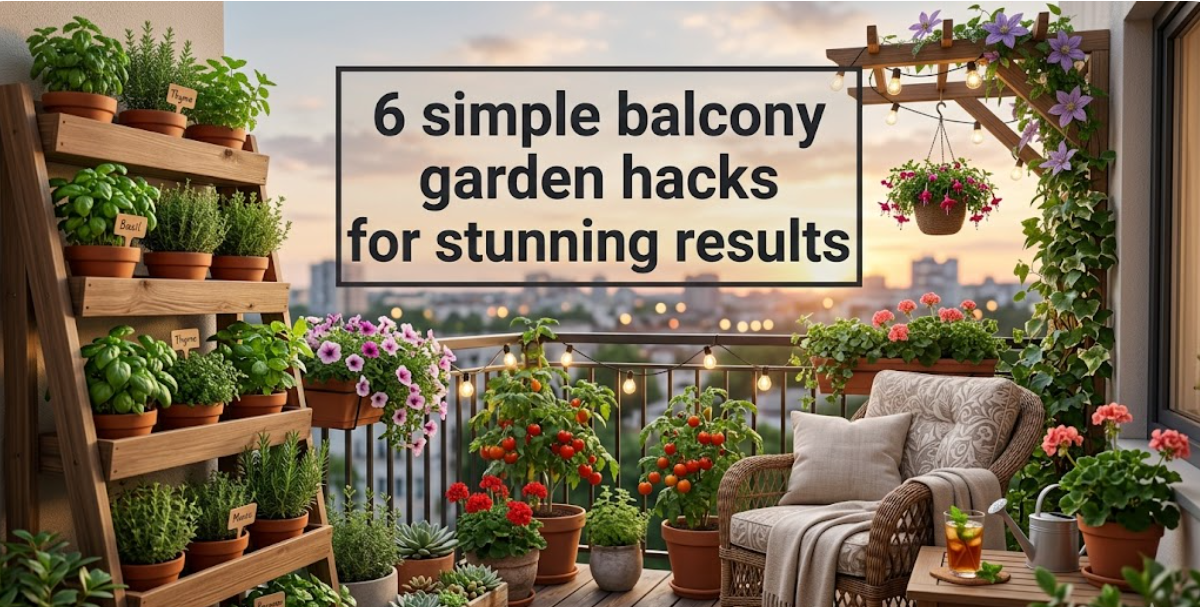
Balcony gardening often looks easy from the outside: a few green pots, some flowers, maybe a tomato plant hanging over the railing. But anyone who has actually tried it knows the reality is more complicated. Wind dries things out faster than expected. Sunlight changes intensity throughout the day. Pots heat up like ovens. And somehow, plants that should thrive… don’t.
The good news is that balcony gardening doesn’t need complicated systems or expensive setups. In fact, the best results usually come from a few simple, well-applied adjustments that work with the space instead of against it.
This guide breaks down six practical balcony garden hacks that consistently produce stronger growth, healthier plants, and visually impressive results—even in small urban spaces.
hack 1: design your balcony like a mini ecosystem, not a collection of pots
Most balcony gardens fail not because of bad plants, but because of random placement. When pots are placed wherever space allows, plants end up competing for light, airflow, and even attention.
Instead, treat your balcony as a layered ecosystem.
Think in zones:
- hot zone (direct sun, usually railing or outer edge)
- warm zone (partial shade near walls or corners)
- cool zone (shaded floor areas or under shelving)
Once you identify these zones, assign plants based on their natural needs.
balcony zoning structure
| Zone | Conditions | Best Plant Types |
|---|---|---|
| Hot zone | 6–8 hrs direct sun | Tomatoes, chilies, basil |
| Warm zone | 3–5 hrs sun | Mint, coriander, lettuce |
| Cool zone | indirect light/shade | Ferns, parsley, spinach |
Why this works:
Plants stop fighting their environment and start adapting to it. Growth becomes more stable, watering becomes predictable, and leaf burn reduces significantly.
A well-zoned balcony also looks visually intentional—almost like a designed garden rather than scattered containers.
hack 2: build soil that behaves like a living system
Many balcony gardeners underestimate soil. They treat it like a filler. But in container gardening, soil is everything. It is the plant’s entire world—nutrition, water storage, and structural support all in one.
The ideal soil should do three things:
- hold moisture without becoming soggy
- allow air to reach roots
- support microbial life
A reliable “balcony soil formula” looks like this:
- coco coir or peat: moisture balance
- compost: nutrients
- perlite/sand: drainage
- vermicompost: biological activity
soil performance comparison chart
| Soil Type | Water Retention | Aeration | Nutrient Supply | Root Health |
|---|---|---|---|---|
| Plain garden soil | Medium | Low | Medium | Weak |
| Basic potting mix | Medium | Medium | Medium | Average |
| Balanced balcony mix | High | High | High | Strong |
What changes when soil improves:
Plants stop showing stress symptoms like yellowing leaves or sudden wilting. Watering becomes more predictable. Fertilizer works more effectively because roots can actually absorb nutrients efficiently.
A hidden advantage is long-term stability. Good soil reduces the need for constant intervention.
hack 3: use vertical layering to double usable space
Balconies don’t have much floor space, but they usually have unused vertical space. Most gardeners ignore this and end up limiting their yield unnecessarily.
Vertical layering means stacking plants by height and light need—not just placing pots side by side.
A simple structure:
- top layer: sun-loving plants
- middle layer: medium-light plants
- bottom layer: shade-tolerant plants
vertical planting arrangement
| Level | Light Exposure | Suitable Plants |
|---|---|---|
| Top shelves | full sun | tomatoes, peppers, herbs |
| Mid shelves | filtered sunlight | spinach, coriander |
| Floor level | low light | mint, parsley, ferns |
Why this works:
It mimics natural plant ecosystems, where taller plants provide partial shade to smaller ones. It also reduces heat stress on sensitive plants by naturally filtering sunlight.
Another benefit is airflow improvement. Proper layering reduces overcrowding, which lowers pest problems and fungal issues.
hack 4: switch from watering schedules to soil-based watering
One of the most common mistakes in balcony gardening is watering on a fixed schedule—every morning, every evening, or every alternate day. But plants don’t follow schedules. They follow soil moisture levels.
Overwatering is actually more harmful than underwatering in most balcony setups.
Instead of guessing, use a simple rule:
- if soil feels dry 2–3 cm below surface → water deeply
- if still moist → wait
watering method effectiveness chart
| Method | Water Efficiency | Root Strength | Risk Level |
|---|---|---|---|
| Daily light watering | Low | Weak | High (rot) |
| Deep occasional water | High | Strong | Low |
| Self-watering system | Very high | Very strong | Very low |
Better watering habits improve root depth. Deeper roots make plants more resistant to heat, wind, and short dry periods.
A simple upgrade like mulching (dry leaves, coco husk, straw) can reduce watering frequency by up to 40%.
hack 5: choose plants that match balcony reality, not gardening dreams
A major reason balcony gardens fail is unrealistic plant selection. People often choose plants based on appearance rather than suitability.
The key is to prioritize three traits:
- compact growth
- fast maturity
- container adaptability
best-performing balcony crops
| Plant | Growth Time | Space Need | Success Rate |
|---|---|---|---|
| cherry tomato | 60–80 days | medium | very high |
| spinach | 30–40 days | low | very high |
| chili pepper | 70–90 days | low-medium | high |
| basil | 20–30 days | low | very high |
| mint | perennial | low | extremely high |
Why this matters:
Fast-growing plants provide visible success early, which encourages consistency. Compact plants also reduce maintenance and prevent overcrowding.
A hidden strategy is “stacked harvesting”—choosing plants that regrow after cutting (like basil and mint). This extends productivity without replanting.
hack 6: use reflection, shade, and airflow to manipulate growth conditions
Balcony environments are shaped more by architecture than nature. Walls reflect heat, railings block airflow, and neighboring buildings create unpredictable shade patterns.
Instead of fighting these conditions, you can use them strategically.
three environmental modifiers:
- reflection: increases light using white walls or reflective boards
- shading: reduces heat stress using cloth or mesh
- airflow control: improves plant health by reducing stagnation
environment control impact table
| Factor | Tool/Method | Effect on Plants |
|---|---|---|
| Light boost | white surface panel | faster growth |
| Heat control | shade cloth | prevents leaf burn |
| Airflow | spacing + elevation | reduces fungus & pests |
Why this works:
Plants are highly responsive to micro-environment changes. Even small adjustments in heat or airflow can shift growth speed significantly.
For example, placing reflective material behind herbs can increase usable light without adding heat stress.
combining all six hacks into a working system
Individually, each hack improves one aspect of gardening. But the real transformation happens when they are combined into a system.
system performance overview
| Hack | Immediate Impact | Long-term Impact |
|---|---|---|
| micro zoning (hack 1) | high | very high |
| soil system (hack 2) | medium | very high |
| vertical layering (hack 3) | high | high |
| smart watering (hack 4) | high | very high |
| plant selection (hack 5) | medium | high |
| environment control (hack 6) | high | high |
When all six are applied together, balcony gardening shifts from unpredictable to stable, and from decorative to productive.
common mistakes that block results
Even with good techniques, a few recurring mistakes can slow progress:
- using containers without drainage holes
- overcrowding plants in a single pot
- ignoring wind exposure on upper floors
- mixing incompatible plant types
- relying only on store-bought fertilizer
These issues often cancel out otherwise good gardening practices.
why these hacks actually work (the hidden principle)
All six hacks share a common principle: they reduce stress on plants.
Plants don’t fail because they lack effort—they fail because they are constantly adjusting to unstable conditions.
These hacks stabilize:
- temperature
- water availability
- root environment
- light exposure
- space competition
Once stability increases, growth becomes automatic rather than forced.
quick summary table
| Area improved | Main hack involved | Result |
|---|---|---|
| Soil health | hack 2 | stronger roots |
| Space usage | hack 3 | higher yield |
| Water control | hack 4 | fewer plant losses |
| Plant choice | hack 5 | faster success |
| Environment | hack 6 | healthier leaves |
| Layout planning | hack 1 | balanced ecosystem |
faqs
- how many plants can I grow in a small balcony
It depends on vertical usage and container size, but most small balconies can support 8–15 well-planned plants without overcrowding. - what is the easiest plant for beginners
Mint, basil, and spinach are among the easiest because they grow quickly and tolerate minor mistakes. - how often should balcony soil be replaced
Partial soil refresh every 6–12 months is enough. Full replacement is usually not necessary unless disease is present. - do balcony gardens need fertilizer often
Light feeding every 2–3 weeks is usually sufficient, especially if compost is part of the soil mix. - why do balcony plants dry out faster than ground plants
Wind exposure, smaller soil volume, and heat reflection from walls increase evaporation rates. - can balcony gardening work without direct sunlight
Yes, but plant selection becomes more limited. Shade-tolerant crops like mint, parsley, and ferns perform best.
A successful balcony garden is not built through complexity. It is built through small corrections that add up: better soil, smarter watering, thoughtful placement, and realistic plant choices. Once these elements align, even a small balcony can turn into a surprisingly productive green space.