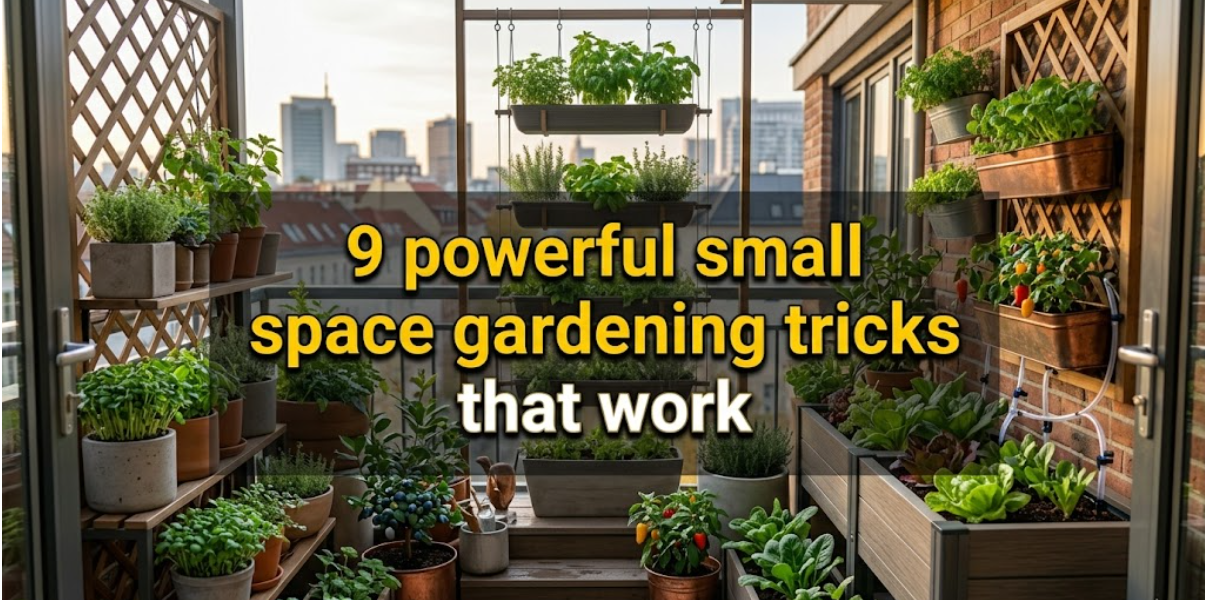
Small space gardening has become one of the most practical ways to bring greenery, food production, and calmness into modern urban life. Whether it’s a tiny balcony, a compact rooftop corner, a window ledge, or a narrow indoor strip near a wall, limited space doesn’t mean limited possibilities. In fact, small spaces often allow better control, faster experimentation, and surprisingly higher productivity when used correctly.
The real difference between a struggling small garden and a thriving one is not space—it’s strategy. Once you understand how to layer plants, manage light, optimize containers, and design micro-ecosystems, even a few square feet can behave like a miniature farm.
This guide breaks down 9 powerful small space gardening tricks that actually work in real conditions. Along the way, you’ll find practical tables, comparison charts, and structured systems you can apply immediately.
trick 1: think in layers, not in square feet
Most beginners treat small gardening like floor space only. Advanced small-space gardeners think vertically, horizontally, and even temporally.
Instead of asking “how many pots fit here?”, ask “how many layers of growth can this space support?”
vertical layering structure
| Layer Level | Light Exposure | Best Plant Types |
|---|---|---|
| Upper layer | High sunlight | Tomatoes, peppers, beans |
| Middle layer | Medium light | Herbs, spinach, chilies |
| Lower layer | Low light / shade | Mint, lettuce, ferns |
| Hanging layer | Variable light | Strawberries, trailing plants |
This approach multiplies growing capacity without expanding physical area. It also reduces competition between plants because each layer uses a different light zone.
A layered system creates a natural “mini forest effect,” where plants support each other’s microclimate.
trick 2: choose containers based on root behavior, not plant size
One of the most misunderstood aspects of small gardening is container selection. People often choose pots based on how big a plant looks above soil, but the real limitation is below the soil.
root depth requirement table
| Plant Type | Root Depth Needed | Ideal Container |
|---|---|---|
| Leafy greens | 6–8 inches | Shallow trays |
| Herbs | 6–10 inches | Medium pots |
| Tomatoes | 12–18 inches | Deep buckets |
| Root vegetables | 10–14 inches | Wide deep pots |
Understanding root behavior allows you to stack more plants in tighter configurations without stunting growth.
Another trick is using rectangular containers instead of round pots—they maximize usable surface area.
trick 3: use “light mapping” instead of guessing sunlight
In small spaces, sunlight is rarely uniform. One corner may get strong morning sun while another stays shaded all day. Instead of guessing, map light movement across your space.
simple light mapping method:
- observe sunlight every 2 hours
- mark bright, medium, and shaded zones
- track changes over 3 days
light distribution chart example
| Time | Sunny Zone | Partial Shade | Full Shade |
|---|---|---|---|
| 8–10 AM | East corner | Center | West wall |
| 12–2 PM | Center | Edge zones | Balcony side |
| 4–6 PM | West side | Center | East corner |
Once mapped, you can assign plants strategically instead of randomly placing them.
trick 4: create a self-watering micro system
Small spaces heat up and dry out quickly, especially in balconies or rooftops. Instead of watering multiple times a day, build a passive water system.
simple methods include:
- wick watering using cotton ropes
- bottom water trays
- bottle drip systems
- reservoir planters
water efficiency comparison
| Method | Water Efficiency | Maintenance |
|---|---|---|
| Manual watering | Low | High effort |
| Drip bottles | Medium | Low effort |
| Wick system | High | Very low |
| Reservoir pots | Very high | Minimal |
Self-watering systems stabilize moisture levels, which is crucial in restricted soil volumes.
trick 5: use fast-cycle planting instead of seasonal waiting
Small space gardening cannot afford long idle periods. Instead of waiting for full seasons, use fast-cycle planting.
fast-cycle crop examples:
- lettuce (25–30 days)
- radish (20–25 days)
- spinach (30–40 days)
- coriander (20–30 days)
crop cycle comparison table
| Crop | Growth Time | Harvest Frequency |
|---|---|---|
| Lettuce | Fast | Multiple cycles |
| Spinach | Medium | Continuous cut |
| Tomato | Slow | Seasonal |
| Radish | Very fast | Single cycle |
By continuously rotating fast crops, your space never goes inactive.
trick 6: stack nutrients using layered soil systems
Instead of mixing all soil ingredients uniformly, small-space gardening benefits from layered soil structures.
soil layering method:
- bottom layer: drainage (gravel or broken pottery)
- middle layer: nutrient-rich compost mix
- top layer: mulch or coco peat
soil layer function chart
| Layer | Purpose |
|---|---|
| Bottom | Drainage control |
| Middle | Nutrient storage |
| Top | Moisture retention |
This structure improves root oxygen flow and reduces overwatering risks.
trick 7: convert walls into productive growing surfaces
Walls are often ignored in small spaces, but they are one of the most valuable gardening assets.
vertical wall systems:
- pocket planters
- hanging bottle gardens
- grid trellis systems
- modular wall pots
space efficiency comparison
| System | Space Usage | Yield Output |
|---|---|---|
| Floor pots | Low | Medium |
| Vertical wall | High | High |
| Hanging systems | Very high | Very high |
Wall gardening allows you to multiply growing area without increasing floor clutter.
trick 8: practice plant pairing instead of isolation planting
In small spaces, plants cannot be isolated efficiently. Pairing compatible plants improves growth, pest resistance, and space usage.
beneficial plant pairs:
- tomato + basil
- carrot + onion
- lettuce + spinach
- mint + cabbage (with control)
plant pairing benefits table
| Pair Type | Benefit |
|---|---|
| Aromatic + veggie | Pest control |
| Deep + shallow | Space efficiency |
| Fast + slow | Continuous harvest |
Companion planting creates a shared ecosystem rather than competing individuals.
trick 9: control growth speed with pruning and pinching
In small spaces, uncontrolled growth becomes overcrowding very quickly. Managing plant shape is essential.
pruning effects:
- increases branching
- improves airflow
- prevents space domination
- boosts fruit production
growth control chart
| Action | Result |
|---|---|
| Pinching | Bushier growth |
| Cutting | Controlled height |
| Thinning | Better airflow |
For example, regularly pinching basil leads to fuller plants instead of tall, weak stems.
integrated small space gardening system
When all nine tricks work together, they form a compact but highly efficient gardening system.
system overview table
| System Layer | Function |
|---|---|
| Vertical stacking | Space expansion |
| Root-based containers | Growth optimization |
| Light mapping | Energy efficiency |
| Self-watering | Stability |
| Fast-cycle crops | Continuous output |
| Soil layering | Nutrient balance |
| Wall gardening | Space multiplication |
| Plant pairing | Ecosystem support |
| Pruning control | Structural management |
This system transforms even the smallest area into a productive, balanced ecosystem.
common mistakes in small space gardening
Even with good techniques, certain habits can reduce success:
- overcrowding containers
- ignoring light differences
- using only decorative pots without drainage
- overwatering due to small soil volume
- planting slow crops only
Avoiding these mistakes often improves results more than adding new techniques.
weekly maintenance structure for small gardens
| Day | Task |
|---|---|
| Monday | Water check |
| Tuesday | Pest inspection |
| Wednesday | Prune and trim |
| Thursday | Fertilizer rotation |
| Friday | Adjust light positioning |
| Saturday | Harvest fast crops |
| Sunday | Clean and reorganize space |
Consistency matters more than intensity in small space systems.
final thoughts
Small space gardening is not about limitations—it’s about design intelligence. When you understand how light moves, how roots behave, how plants interact, and how space can be layered, even the tiniest corner becomes productive.
The nine tricks in this guide are not isolated ideas. They form a system that turns static space into a dynamic growing environment. Once implemented together, they create continuous harvests, healthier plants, and far better use of every inch available.
In small gardening, success doesn’t come from having more space—it comes from using the same space more intelligently.
frequently asked questions
- what is the best plant for very small spaces?
Leafy greens like lettuce, spinach, and herbs like basil and mint perform best because they grow quickly and require minimal root space. - how can I increase yield in a small garden?
Use vertical gardening, fast-cycle crops, and companion planting to maximize output per square foot. - do small gardens need daily watering?
Not always. It depends on temperature and container size. Self-watering systems can reduce the need for daily watering. - can vegetables grow in containers long-term?
Yes, as long as containers are deep enough and soil nutrients are replenished regularly. - what is the biggest mistake in small space gardening?
Overcrowding plants without considering light and root space is the most common issue. - how do I make my small balcony garden more productive year-round?
Combine fast-growing crops, rotate planting cycles, and use vertical systems to maintain continuous production.