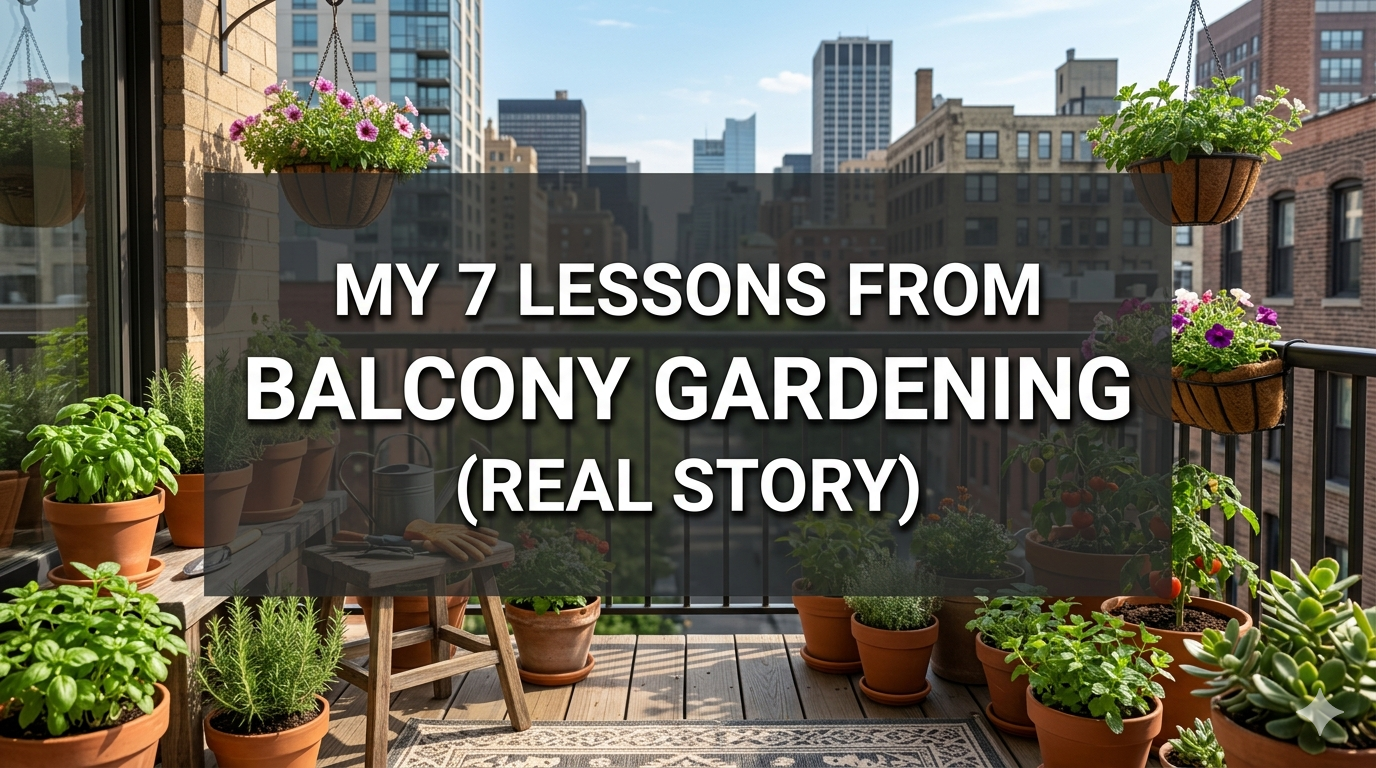
I didn’t start balcony gardening because I had a plan. I started because I was frustrated with empty space.
My balcony was small, slightly uneven, and mostly ignored. It collected dust more than attention. One day, I placed a single pot there—not because I knew what I was doing, but because I wanted to see if something green could survive in that corner of concrete and sunlight.
That one pot turned into a handful. Then a collection. Then a small system I had to learn how to manage.
What I didn’t expect was how many lessons would come from such a small space.
These are the seven most important lessons I learned—not from books or videos, but from watching things grow, fail, and recover right in front of me.
lesson 1: plants don’t fail quickly—care systems do
At the beginning, I thought plant failure was sudden. A plant looked fine one day and wilted the next. That’s how it felt.
But over time, I realized something important: plants don’t usually fail suddenly. The care system around them slowly breaks down.
It could be:
- inconsistent watering
- wrong pot size
- poor soil drainage
- too much attention or too little
The plant is just the final expression of that imbalance.
plant health breakdown chart
| cause of issue | visible symptom | real underlying problem |
|---|---|---|
| yellow leaves | nutrient deficiency | poor soil mix |
| drooping | dehydration | inconsistent watering |
| slow growth | weak roots | compact soil |
| leaf burn | dry tips | excess sunlight exposure |
Once I understood this, I stopped blaming individual plants and started fixing systems instead.
lesson 2: small spaces punish mistakes faster
A large garden can hide errors. A balcony cannot.
In a small space, every mistake shows up quickly because everything is concentrated—light, heat, airflow, water.
I learned this the hard way when I overwatered three pots in a row, thinking I was being “consistent.” Within days, the soil smelled off and leaves started yellowing.
That was my first introduction to how unforgiving small environments can be.
space sensitivity comparison
| garden size | error visibility | recovery speed | forgiveness level |
|---|---|---|---|
| large garden | low | slow | high |
| medium garden | moderate | medium | moderate |
| balcony garden | high | fast | low |
Small spaces don’t allow you to hide mistakes—but they also teach you faster than anything else.
lesson 3: sunlight is more complicated than “more is better”
I used to think plants simply needed sunlight. The more, the better.
Then I noticed something strange: some plants were thriving in partial shade while others were struggling in full sun—even though they were labeled “sun-loving.”
The issue wasn’t sunlight itself. It was timing, intensity, and reflection from walls.
sunlight behavior breakdown
| condition | plant reaction | outcome |
|---|---|---|
| morning sun | gentle growth | healthy leaves |
| afternoon sun | heat stress | curling leaves |
| reflected heat | sudden drying | scorched edges |
| filtered light | balanced growth | steady health |
Once I started tracking sunlight instead of assuming it, I began moving plants throughout the season rather than leaving them in fixed positions.
lesson 4: watering mistakes are more dangerous than drought
This was probably my biggest early mistake.
I believed that watering frequently was safer than underwatering. It felt responsible. It wasn’t.
Overwatering slowly suffocates roots by reducing oxygen availability in soil. But because the surface still looks wet and green, the damage is invisible until it’s advanced.
watering impact comparison table
| watering habit | short-term effect | long-term result |
|---|---|---|
| too frequent | fresh appearance | root rot risk |
| too little | slight droop | slow dehydration |
| balanced | stable growth | healthy roots |
Eventually, I stopped watering on schedule and started checking soil conditions instead.
That single change saved more plants than anything else.
lesson 5: plant grouping matters more than plant type
At one point, my balcony looked diverse and colorful—but everything was struggling in different ways.
The problem wasn’t the plants. It was how I grouped them.
I had placed plants based on appearance instead of behavior. That meant:
- water-loving plants next to drought-tolerant ones
- sun-sensitive plants in full exposure
- fast-growing plants crowding slow ones
Once I regrouped them by needs instead of looks, everything became easier.
plant grouping system
| group type | examples | care requirement |
|---|---|---|
| high water need | basil, mint | frequent watering |
| low water need | succulents | minimal watering |
| medium need | tomatoes, peppers | balanced care |
| shade lovers | leafy greens | indirect light |
This reduced both plant stress and my workload significantly.
lesson 6: pruning is communication, not destruction
I used to avoid cutting plants. It felt wrong to remove healthy-looking parts.
But over time, I noticed something: unpruned plants become chaotic. They grow outward instead of upward, block light from each other, and weaken structurally.
When I finally started pruning regularly, the results were immediate.
pruning effect chart
| pruning level | plant shape | growth pattern |
|---|---|---|
| no pruning | tall, thin | weak structure |
| light pruning | controlled shape | steady growth |
| regular pruning | dense and healthy | strong productivity |
Pruning wasn’t damage—it was direction.
lesson 7: observation is more powerful than tools
I once believed better gardening required better equipment. Better pots, better fertilizers, better watering cans.
But most improvements came from something simpler: noticing patterns.
I started sitting quietly in the balcony for a few minutes every day. No tasks. Just observation.
That habit revealed things I had been missing:
- which pots dried faster
- which corners got less light
- which plants reacted to wind exposure
simple observation log
| observation type | insight gained | action taken |
|---|---|---|
| leaf movement | wind stress | relocation |
| soil drying speed | pot material effect | container change |
| color changes | nutrient imbalance | feeding adjustment |
Once I started observing instead of reacting, gardening became much more predictable.
what these 7 lessons created together
Individually, each lesson improved one part of my balcony garden. But together, they changed how I think about systems entirely.
I stopped seeing gardening as “plant care” and started seeing it as environmental management.
balcony transformation timeline
| phase | condition | key learning outcome |
|---|---|---|
| month 1 | random setup | basic survival |
| month 3 | inconsistent growth | watering awareness |
| month 6 | partial stability | grouping + sunlight |
| month 9 | structured system | pruning + observation |
| month 12 | balanced ecosystem | seasonal adaptation |
By the end, the balcony wasn’t just greener—it was more predictable, more stable, and surprisingly easier to maintain.
faqs
- what is the most common mistake in balcony gardening?
Overwatering and ignoring sunlight patterns are the two most common mistakes. - how often should balcony plants be watered?
There is no fixed schedule. Water only when soil conditions indicate dryness. - can small balconies really support multiple plants?
Yes, if plants are grouped properly and vertical space is used efficiently. - why do some plants fail even with proper care?
Most failures come from mismatched conditions like soil type, light exposure, or pot size—not neglect. - is pruning necessary for all plants?
Not all, but most benefit from light pruning to maintain shape and encourage healthier growth. - how long does it take to stabilize a balcony garden?
Typically 6–12 months depending on plant variety and environmental consistency.
—
A balcony garden doesn’t teach you how to grow plants. It teaches you how to notice systems.
Once you understand that, even the smallest space starts behaving differently—not because it changes, but because you do.