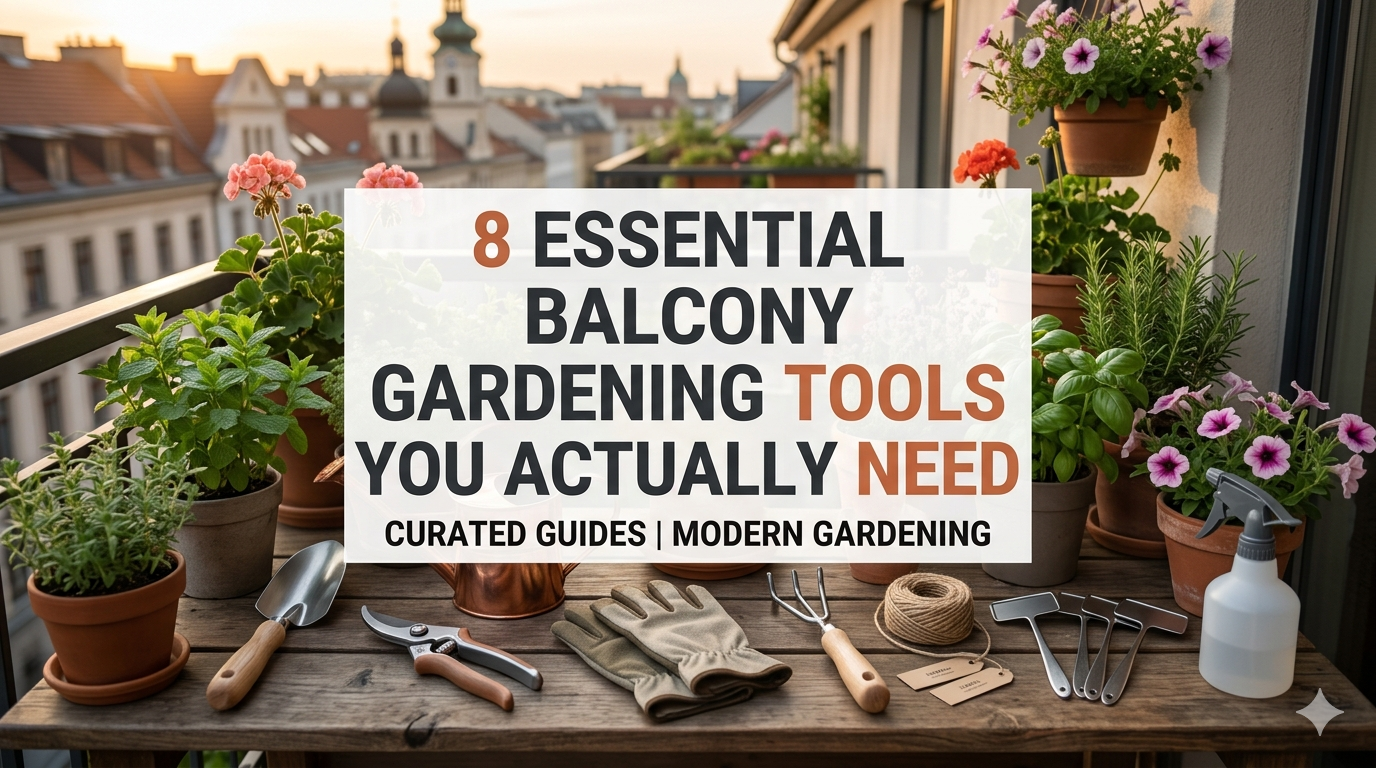
Balcony gardening has a reputation for being simple—just a few pots, some soil, and plants you like. But anyone who has actually tried it quickly realizes something different: the smaller the space, the more precision you need. Unlike large gardens where nature absorbs inefficiencies, balcony gardens depend heavily on control, timing, and the right tools.
That doesn’t mean you need a shed full of equipment. In fact, one of the biggest mistakes beginners make is overbuying tools they rarely use. Balcony gardening works best when your toolkit is lean, functional, and adapted to confined spaces.
This guide breaks down eight essential balcony gardening tools you actually need, why they matter, how they perform in small environments, and how to choose versions that suit your space. Along the way, you’ll find tables and comparison charts that make decision-making easier and more practical.
tool 1: compact hand trowel (the everyday essential)
A hand trowel is the most frequently used tool in any balcony garden. It is used for digging, potting, transplanting, mixing soil, and removing weeds. In small spaces, a compact version is far more effective than larger garden trowels.
A good balcony trowel should be lightweight, rust-resistant, and narrow enough to work inside small pots.
Comparison of trowel types:
| Type | Best Use | Space Suitability | Durability | Ease of Use |
|---|---|---|---|---|
| Full-size trowel | Outdoor soil beds | Low | High | Moderate |
| Compact trowel | Pots and containers | Very High | Medium-High | Very Easy |
| Foldable trowel | Portable gardening | Medium | Medium | Easy |
Why it matters in balcony gardening:
- Prevents soil spillage in tight containers
- Allows precise root handling
- Reduces strain during repeated use
- Fits into small storage areas
In balcony gardening, precision is more valuable than power—and the trowel is the tool that defines that precision.
tool 2: pruning shears (for controlled plant shaping)
Plants in balconies grow in limited directions. Without regular pruning, they become overcrowded, weak, or uneven. Pruning shears allow you to control plant shape, remove dead parts, and encourage healthy growth.
There are three common types:
- Bypass shears (clean cuts for live plants)
- Anvil shears (for dry or dead branches)
- Micro snips (for herbs and delicate plants)
Pruning tool comparison:
| Tool Type | Precision Level | Best For | Maintenance |
|---|---|---|---|
| Bypass shears | High | Live stems, flowers | Moderate |
| Anvil shears | Medium | Dry branches | Low |
| Micro snips | Very High | Herbs, small plants | Low |
Why pruning matters in small spaces:
- Prevents overcrowding in tight pots
- Improves airflow between plants
- Encourages bushier, healthier growth
- Reduces pest hiding spots
A balcony garden without pruning quickly becomes visually chaotic and biologically imbalanced.
tool 3: watering can with narrow spout
Watering seems simple, but in balcony gardening, control matters more than volume. A watering can with a narrow spout ensures water goes directly to the soil without splashing leaves or washing away nutrients.
Different watering tools compared:
| Tool | Control Level | Water Efficiency | Best For |
|---|---|---|---|
| Bucket | Low | Poor | Large plants only |
| Standard watering can | Medium | Good | General use |
| Narrow-spout can | High | Very Good | Balcony pots |
| Spray bottle | Very High (fine mist) | Excellent | Herbs, seedlings |
Key benefits:
- Prevents overwatering in small pots
- Reduces fungal disease caused by wet leaves
- Improves root-targeted watering
- Minimizes water waste
In balconies, overwatering is often more damaging than underwatering. A controlled watering tool prevents that imbalance.
tool 4: quality potting mix scoop or mini shovel
While it may seem minor, a dedicated soil scoop makes potting cleaner, faster, and more efficient. Using hands or makeshift tools often leads to uneven soil distribution and mess in confined spaces.
Soil handling tools comparison:
| Tool | Cleanliness | Efficiency | Suitability |
|---|---|---|---|
| Hands | Low | Medium | Small tasks |
| Kitchen spoon | Low | Low | Temporary use |
| Mini soil scoop | High | High | Balcony gardening |
| Wide shovel | Medium | High | Large containers |
Why it matters:
- Keeps balcony clean and organized
- Helps distribute soil evenly in containers
- Reduces spillage in tight spaces
- Speeds up repotting and mixing tasks
In small-space gardening, cleanliness is not cosmetic—it directly affects workflow and maintenance ease.
tool 5: compact pruning saw (for woody plants)
While most balcony plants are small, some like dwarf fruit trees or larger ornamental shrubs develop woody stems. For these, pruning shears are not enough. A compact pruning saw becomes necessary.
Comparison of cutting tools:
| Tool | Best Use | Precision | Effort Required |
|---|---|---|---|
| Micro snips | Herbs | Very High | Very Low |
| Shears | Small branches | High | Low |
| Pruning saw | Woody stems | Medium | Medium |
| Full saw | Trees | Low | High |
Benefits:
- Handles thicker stems without damaging plant structure
- Ensures clean cuts that heal faster
- Useful for seasonal maintenance of larger balcony plants
Even if used occasionally, it is essential for long-term balcony garden health.
tool 6: stackable planters or modular containers
Containers are not just holding units—they define how efficiently your balcony space is used. Stackable or modular planters allow vertical growth, mobility, and seasonal rearrangement.
Container system comparison:
| Type | Space Efficiency | Flexibility | Drainage Control |
|---|---|---|---|
| Basic pots | Low | Low | Medium |
| Stackable planters | Very High | High | High |
| Modular trays | High | Very High | Medium |
| Hanging containers | High | Medium | High |
Why they matter:
- Maximize limited balcony floor space
- Enable vertical gardening
- Allow crop rotation in tight areas
- Simplify seasonal rearrangement
In compact environments, the container system often matters more than the plant itself.
tool 7: soil moisture meter (precision watering control)
One of the biggest challenges in balcony gardening is guessing when to water. A soil moisture meter removes uncertainty by measuring moisture levels directly at the root zone.
Moisture monitoring comparison:
| Method | Accuracy | Ease | Risk of Error |
|---|---|---|---|
| Finger test | Medium | Easy | Medium |
| Visual inspection | Low | Easy | High |
| Moisture meter | High | Very Easy | Low |
Benefits:
- Prevents overwatering and root rot
- Helps adjust watering across seasons
- Useful for sensitive plants like herbs and seedlings
- Reduces guesswork
This tool is especially useful for beginners who are still learning soil behavior in containers.
tool 8: lightweight plant support system (stakes, nets, clips)
Many balcony plants—especially tomatoes, peppers, and climbers—need support to grow properly. Without support, stems break, fruits drop, and plants spread uncontrollably.
Support system types:
| System | Best For | Stability | Installation Effort |
|---|---|---|---|
| Bamboo stakes | Small plants | Medium | Easy |
| Metal cages | Tomatoes, peppers | High | Medium |
| Net trellis | Climbers | High | Medium |
| Plastic clips | Delicate stems | Low | Very Easy |
Why support systems matter:
- Prevent structural damage in wind
- Improve fruit production
- Save space by guiding vertical growth
- Keep balcony visually organized
A supported plant grows with intention; an unsupported one grows randomly.
complete balcony tool efficiency overview
| Tool | Frequency of Use | Importance Level | Impact on Plant Health |
|---|---|---|---|
| Trowel | Very High | Essential | High |
| Pruning shears | High | Essential | High |
| Watering can | Very High | Essential | Very High |
| Soil scoop | Medium | Important | Medium |
| Pruning saw | Low | Situational | High (long-term) |
| Planters | Constant | Structural | Very High |
| Moisture meter | High | Important | High |
| Support system | Medium | Essential for certain plants | High |
how to build a practical balcony gardening toolkit
Instead of buying everything at once, it is more effective to build your toolkit in phases.
Starter phase:
- Trowel
- Watering can
- Basic pots
- Pruning shears
Growth phase:
- Moisture meter
- Soil scoop
- Stackable planters
Advanced phase:
- Pruning saw
- Support systems
- Modular setups
This phased approach avoids unnecessary spending and ensures tools match actual gardening needs.
common mistakes people make with balcony tools
| Mistake | Problem | Solution |
|---|---|---|
| Buying oversized tools | Hard to use in small pots | Choose compact versions |
| Ignoring drainage tools | Root rot issues | Use proper watering systems |
| Skipping pruning tools | Overgrown plants | Maintain regular trimming |
| Using random containers | Poor growth control | Standardize planter systems |
maintenance habits for tools
| Tool | Cleaning Frequency | Storage Requirement |
|---|---|---|
| Trowel | After use | Dry storage |
| Shears | Weekly | Oiled blades |
| Watering can | Monthly | Clean interior |
| Moisture meter | Occasional | Dry place |
| Support systems | Seasonal | Disassemble if needed |
Proper maintenance extends tool life and improves gardening efficiency.
frequently asked questions
- do I really need all 8 tools for balcony gardening?
Not immediately. You can start with 3–4 essentials like a trowel, watering can, and pruning shears, then expand as your garden grows. - what is the most important balcony gardening tool?
The watering can is arguably the most important because improper watering is the most common cause of plant failure in containers. - can I use household items instead of gardening tools?
Yes, but only temporarily. Kitchen spoons and bottles can work initially, but dedicated tools improve precision and reduce plant stress. - how often should I replace gardening tools?
Good-quality tools can last years if maintained properly. Replacement is only needed when rust, breakage, or poor performance appears. - are expensive tools better for small gardens?
Not necessarily. In balcony gardening, compactness and usability matter more than price or brand. - what tool helps most with beginners?
A soil moisture meter helps beginners avoid overwatering, which is one of the most common early mistakes.
closing perspective
Balcony gardening is not about having more tools—it is about having the right ones. Each tool plays a specific role in shaping how efficiently your small space functions. When chosen thoughtfully, even a handful of tools can support a surprisingly productive and well-balanced garden.
Over time, your toolkit becomes less about equipment and more about rhythm—how you interact with your plants, observe their needs, and respond with small, consistent actions. In that sense, tools are not just objects; they are extensions of how you care for a living space that continues to evolve with you.