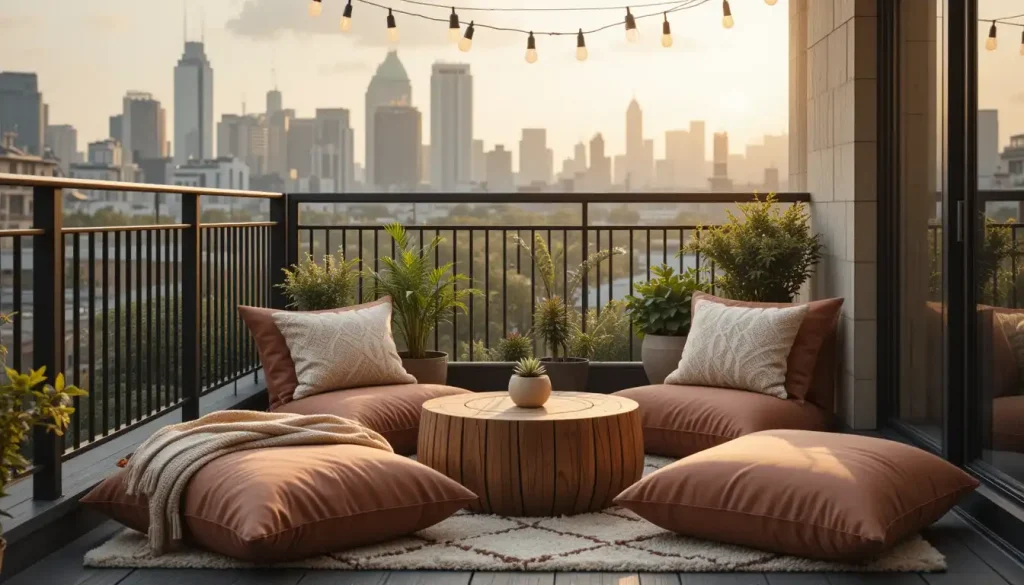
My first balcony setup was a disaster. Not in a dramatic way — it just felt… suffocating. Like a cluttered storage room that happened to be outdoors. I had a big plastic table taking up half the floor, pots scattered everywhere with no logic, and a couple of mismatched chairs shoved into the corners. Every time I stepped out there, I felt cramped instead of relaxed.
The funny part? The balcony wasn’t actually small. It was a decent size for an apartment. But the way I had set it up made it feel like a closet.
It took me a while — and a few embarrassing Pinterest rabbit holes — to realize that the problem wasn’t the space. It was every single decision I had made about how to use it. Once I started fixing those decisions one by one, the same balcony started feeling open, usable, and honestly kind of nice to sit in.
If your balcony feels tighter than it should, there’s a good chance you’re making at least one (probably more) of these six mistakes.
1. Choosing Furniture That’s Too Big for the Space
This is the number one offender. And I say that as someone who dragged a four-seater dining set onto a balcony that could barely fit two chairs comfortably.
Big furniture on a small balcony doesn’t just take up physical space — it makes the entire area feel like an obstacle course. You end up squeezing past chairs, bumping into table corners, and eventually just avoiding the balcony altogether because it feels like effort to use.
The fix isn’t to get rid of furniture entirely. It’s to right-size it.
What actually works:
- Bistro sets — a small round table with two chairs takes up a fraction of the space a standard dining set does, and honestly looks better on most balconies.
- Foldable or stackable furniture — chairs that fold flat against a wall or stack on top of each other give you flexibility. Use them when needed, store them when you don’t.
- Bench seating along the railing — a narrow bench with storage underneath runs parallel to the railing and doesn’t eat into the center of your space.
- Wall-mounted fold-down tables — these attach to the wall and fold down when you want to use them, fold flat when you don’t. Brilliant for tiny balconies.
A useful rule of thumb: after placing furniture, you should still be able to walk from the door to the railing without turning sideways. If you can’t, something needs to go.
| Furniture Type | Space Impact | Best For |
|---|---|---|
| Standard 4-seater dining set | Very high | Large terraces only |
| Bistro set (round table + 2 chairs) | Low | Most apartment balconies |
| Foldable chairs + wall-mount table | Minimal | Tiny balconies under 40 sq ft |
| Long bench with storage | Medium | Narrow rectangular balconies |
| Hammock chair (single hook) | Low footprint | Reading nooks, corner spaces |
2. Ignoring Vertical Space Completely
When most people set up a balcony, they think horizontally. Where does this chair go? Where does this plant go? Where does this shelf go? Everything ends up on the floor, which means everything competes for the same limited ground area.
Meanwhile, the walls are completely empty. The railing is bare. The overhead space — if there’s a ceiling or pergola — is untouched.
I made this mistake for almost a full year. My entire balcony setup lived on the floor. Then I added one tiered plant stand and one set of wall-mounted hooks, and suddenly had the same number of plants taking up half the floor space.
Vertical space is free real estate that most people simply forget to use.
Ways to use vertical space without overcomplicating it:
- Mount a pegboard or grid panel on a wall — hang small planters, tools, lanterns, anything.
- Use railing planters that clip onto the outside of the rail — plants hang off the edge instead of sitting on the floor.
- Add a tall narrow shelving unit in a corner — goes up instead of out.
- Hang string lights or a fabric canopy overhead — adds dimension and atmosphere without touching floor space at all.
If you want a deeper look into how vertical setups actually work in practice, these 12 vertical gardens to smarten up any space cover some genuinely clever configurations worth stealing ideas from.
3. Using Too Many Mismatched Elements
This one is subtle but it kills the feeling of space more than people realize.
When I first set up my balcony, I had a green plastic chair, a brown wooden stool, a blue pot, terracotta pots, a striped rug, and a metal lantern. Every single thing was a different style, color, and material. Individually each piece was fine. Together they created visual chaos.
Visual chaos makes a space feel smaller. When your eye has nowhere to rest — when it’s constantly jumping between competing colors, textures, and styles — the space feels busier and tighter than it actually is.
This is the same reason why a well-styled hotel balcony with three matching pieces feels more spacious than a home balcony stuffed with twice as many things in five different styles.
The fix is simpler than it sounds:
Pick two or three materials and stick to them. For example: wood + rattan + terracotta. Or metal + concrete + white fabric. You don’t need everything to match perfectly — you just need them to belong to the same visual family.
Same goes for colors. Choose a simple palette: maybe a neutral base (beige, white, grey) with one accent color (terracotta, sage green, navy). Once you have that, every new thing you add becomes an easy decision.
Before and After Example:
Before: Random assortment — blue plastic chair, red pot, striped outdoor rug, metal shelf, bamboo tray, terracotta pot, string lights in yellow.
After: Rattan chair with white cushion, three matching terracotta pots, a jute rug, wooden side table. Same number of items. Feels like twice the space.
4. Placing Everything Flat on the Floor
Related to the vertical space point, but worth its own section because it’s such a specific and common mistake.
When everything — every pot, every decorative item, every storage basket — sits directly on the floor at the same height, the balcony looks flat and crowded. There’s no visual depth, no layers, nothing to draw your eye upward.
Creating different height levels is one of the easiest ways to make a space feel larger and more intentional.
How to create height variation without spending much:
- Use an upside-down pot or a wooden crate as a riser for another plant — instant height variation.
- Place a tall plant (like a bamboo or a standard-form rosemary) next to shorter ones.
- Use a step ladder shelf — these have multiple levels and look intentional rather than cluttered.
- Hang one or two items at eye level on the wall — a small mirror (yes, on a balcony — it reflects light and makes the space feel bigger), a wall-mounted planter, or a decorative hook with a hanging lantern.
The goal is to have something at three levels: low (floor level), mid (waist to chest height), and high (eye level and above). Once you have all three, the space automatically reads as more layered and open.
For more ideas on how to arrange things smartly in tight corners and odd-shaped spaces, these 7 smart corner ideas for making the most of every space are worth a look — a lot of those principles translate directly to balcony setups.
5. Blocking the Railing View
This one surprised me when I first realized it. I had placed a row of large, bushy plants right along the railing — thinking it would look lush and green. And it did look okay from inside. But standing on the balcony itself felt weirdly claustrophobic.
The reason: I had essentially built a green wall around the perimeter of the space. The view outward — the open sky, the street, whatever is beyond your balcony — is a huge visual cue that your brain uses to feel like the space is open. Block it, and suddenly your brain registers the balcony as a closed box.
The fix:
Keep the area along the railing as open as possible. If you want plants near the railing, use low-growing ones or rail-mounted planters on the outside of the rail so they don’t intrude into your space.
Reserve the taller, bushier plants for corners and walls — places where they add greenery without cutting off your line of sight.
Also, if your balcony has a solid wall railing instead of an open metal or glass one, consider how you can visually “extend” beyond it — a tall mirror on a side wall reflecting the sky, or hanging plants that draw the eye upward and outward.
Railing Planting Guide:
| Plant Type | Best Position | Why |
|---|---|---|
| Tall bushy plants (tomatoes, large herbs) | Back wall or corners | Don’t block sightlines |
| Trailing plants (pothos, string of pearls) | Railing (hanging down outside) | Adds greenery without blocking view |
| Low compact plants (succulents, pansies) | Railing top or inside edge | Stays below sightline |
| Climbing plants | Side wall trellis | Goes vertical, not across view |
6. Neglecting Lighting (and What It Does to Perceived Space)
Most people don’t think about balcony lighting until it’s already dark and they realize they can’t actually use the space at night. But lighting does something during the day too — it determines how warm, open, and inviting a space feels.
A balcony with zero lighting personality (just whatever ambient light comes from inside or from overhead) often feels flat. The same balcony with some warm string lights, a lantern, or a solar-powered lamp feels instantly cozier and — counterintuitively — more spacious. Good lighting creates depth and atmosphere.
Here’s what I’ve actually tried and what worked:
String lights (fairy lights): The easiest win. Run them along the ceiling edge or zigzag them across the overhead space. Warm white works better than cool white — it makes everything feel softer. These are cheap, available everywhere, and make an immediate difference.
Solar lanterns: Place them at floor level in corners or hang them from hooks. No wiring needed. They charge during the day and glow softly at night. I’ve had the same set for two years with zero maintenance.
A single floor lamp: If your balcony has a power outlet, a small outdoor floor lamp in a corner adds a serious “room” feel. It signals that this is a real living space, not just a storage area.
What NOT to do: Don’t use harsh white overhead strip lighting if you can avoid it. It flattens everything and kills the atmosphere completely. Think warm and layered, not bright and uniform.
A well-lit balcony also gets used more. And a used balcony stays tidy because you’re out there regularly — which in turn makes the space feel more intentional and less cramped.
The Pattern Behind All These Mistakes
When you look at all six mistakes together, there’s a clear thread running through all of them: treating the balcony as leftover space rather than actual living space.
Big furniture that doesn’t fit, everything on the floor, mismatched clutter, views blocked by overgrown plants, no lighting — these are all signs of a space that was set up without much intention. Things just got placed wherever they fit in the moment, without thinking about how the space would actually feel to be in.
The shift happens when you start making decisions on purpose. When you ask: does this furniture suit this space? Does this plant placement block my view? Do these pieces belong together visually? Is there anything at eye level? Can I use this space after dark?
None of this requires a big budget or a designer. It just requires slowing down and thinking about the experience of being on the balcony, not just filling it.
| Mistake | Quick Fix | Effort Level |
|---|---|---|
| Oversized furniture | Swap for bistro set or folding chairs | Medium |
| Ignoring vertical space | Add one tiered stand or wall hook | Low |
| Mismatched elements | Edit down to 2-3 materials/colors | Low |
| Everything at floor level | Add risers, tall plant, wall-mounted item | Low |
| Blocking railing view | Move tall plants to corners and walls | Low |
| No lighting | Add string lights or solar lanterns | Very low |
A Few Extra Things Worth Watching Out For
Rugs that are too small: A tiny rug floating in the middle of the balcony floor actually makes the space feel smaller, not cozier. Either go bigger (closer to the actual floor size) or skip the rug entirely.
Too many colors in plants: This sounds strange, but if you have fifteen different flowering plants all in different colors blooming at once, it can read as chaotic. A simple color story — say, all whites and purples, or all warm oranges and yellows — reads as intentional and calm.
Storing things on the balcony that don’t belong there: Old bikes, boxes, broken chairs “waiting to be fixed” — they kill the energy of any space instantly. If something doesn’t serve the balcony’s purpose, it needs to go somewhere else or be dealt with.
If you’re thinking about starting fresh and building your balcony setup more intentionally from the beginning, these 5 easy balcony setup ideas that transformed my tiny space are a solid starting point — practical, not overwhelming, and realistic for most apartment situations.
Getting a balcony to feel open and usable isn’t about having a lot of space. It’s about not working against the space you have. Fix even two or three of these mistakes and you’ll likely feel the difference the same afternoon.