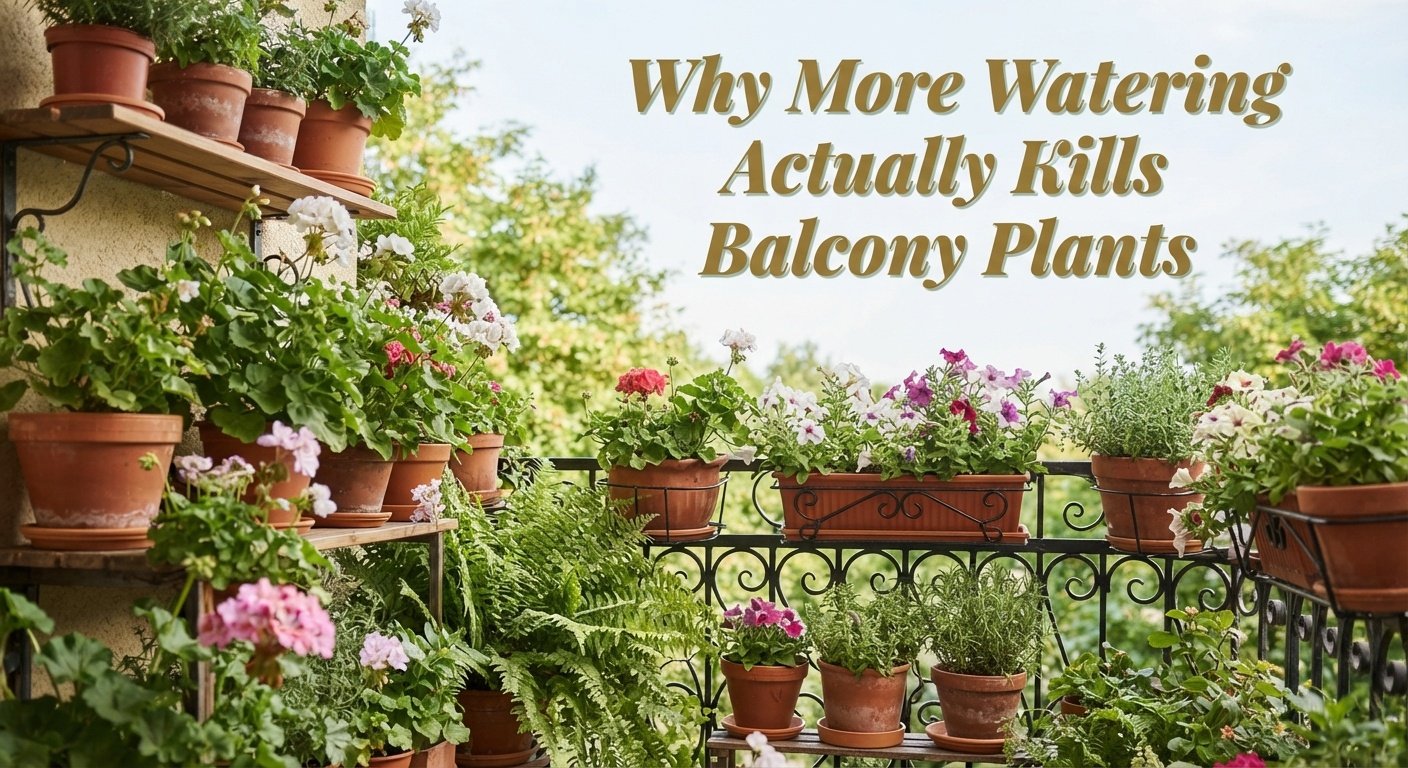
There’s a belief that circulates in almost every balcony gardening group I’ve ever been part of, and it goes something like this: if a plant looks sad, water it. Droopy leaves, yellow tips, slow growth, whatever the symptom, the reflex answer is more water. I believed this too, for longer than I’d like to admit.
It’s wrong more often than it’s right. And on a balcony specifically, where containers already trap moisture differently than garden soil does, that instinct causes more plant deaths than actual drought ever does.
1. The Misconception, Stated Plainly
The belief is that water equals health, so more water equals more health, and a wilting plant is basically begging for a drink. It makes intuitive sense. Plants need water to live, water is scarce during a heatwave, wilting looks like thirst.
But wilting is a symptom, not a diagnosis. A plant wilts when its cells lose turgor pressure, and that can happen for two almost opposite reasons: not enough water reaching the leaves, or root damage that prevents the plant from taking up the water that’s already sitting right there in the pot. Overwatered roots, suffocating in soggy soil, stop functioning properly and the plant wilts exactly like it would from drought. You look at a drooping plant, assume thirst, add water, and you’ve just made the actual problem worse.
2. Why This Is So Different in Containers Than In Ground Soil
In-ground soil has somewhere for excess water to go. It moves sideways, downward, and gets absorbed into a much larger volume of surrounding earth. A container is a closed system. Water goes in, and it can only leave through drainage holes or evaporation, both of which are slower than most people assume, especially with the plastic nursery pots so many balcony plants come in.
According to horticulture research cited by Preen’s overview of common watering myths, researchers at the University of Reading found that container annuals like petunias and impatiens actually bloomed longer and produced more flowers on a fraction of the water most gardeners assume they need, sometimes as little as a few ounces a day. That result surprised a lot of people when it came out, myself included, because it directly contradicts the “soak it daily” advice that gets repeated constantly.
Root systems in containers are also more concentrated in a smaller area. When the growing medium around those roots stays saturated, the air pockets between soil particles fill with water instead of oxygen. Roots, believe it or not, need to breathe. Without oxygen, they stop absorbing nutrients properly and become vulnerable to the fungal pathogens that cause root rot, something the University of Georgia Extension has documented as one of the most common and preventable container plant failures.
3. What Overwatering Actually Looks Like (And How It Differs From Underwatering)
Here’s where people usually go wrong, and I mean this is the single most common mistake I see in my inbox. Someone sends me a photo of a wilting, yellowing plant and asks what fertilizer to use, when the actual issue is root rot from three weeks of daily watering during a mild week.
| Symptom | Overwatering | Underwatering |
|---|---|---|
| Leaf appearance | Yellowing, soft, sometimes translucent | Crispy, curling, dry to the touch |
| Wilting pattern | Wilts even when soil is wet | Wilts and recovers quickly after watering |
| Soil condition | Consistently damp or waterlogged | Dry several inches down, pulls away from pot edges |
| Smell | Sour or musty near the roots | No unusual smell |
| Growth | Slow, mushy stems near soil line | Slow, but stems stay firm |
| Timeline | Symptoms build over 1-2 weeks | Symptoms appear within days |
The soil test matters more than the leaf test. Stick a finger two inches into the pot. If it comes out with damp soil clinging to it and the plant still looks unwell, the problem almost certainly isn’t thirst.
4. How to Actually Water a Balcony Container Correctly
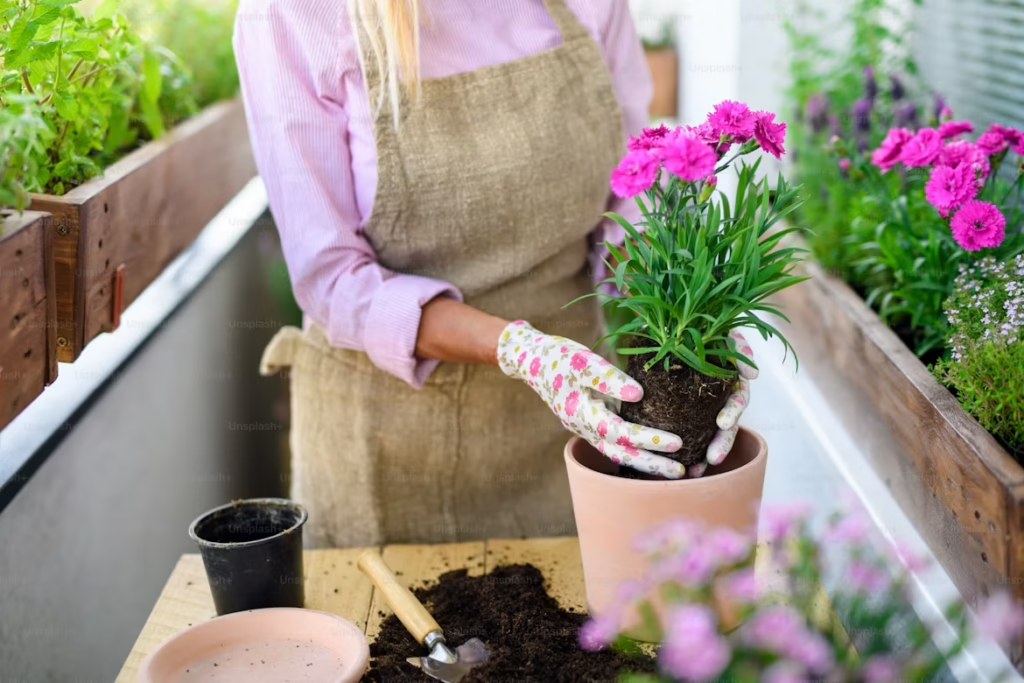
This isn’t about watering less on a fixed schedule. It’s about watering based on what the container is actually telling you, which changes with weather, pot material, and plant size.
A few things I check before I water anything now:
- Finger test two inches down, every time, not just when I remember to.
- Terracotta dries faster than plastic or glazed ceramic, so identical plants in different pot materials need different schedules.
- Morning watering beats evening watering because it gives roots time to take up moisture before the cooler night slows uptake.
- Drainage holes matter enormously. A single small hole in a large pot isn’t enough for fast drainage, and I’ve written a full explanation of why containers need more than one drainage hole if you want the mechanics of it.
And this is something I got wrong for years too. I assumed a heavier pot meant it was retaining water and needed less watering. Actually, weight has more to do with soil density and container material than moisture content, so I stopped trusting that shortcut entirely.
If you’re not sure how fast your specific balcony dries pots out compared to a typical yard, that’s worth understanding on its own, because balcony pots often dry out faster than people expect for reasons that have nothing to do with how much you’re watering. Heat reflected off walls and railings, wind exposure, and pot material all play into it, and getting that baseline right prevents both overwatering and underwatering mistakes.
5. The Soil Underneath All of This
None of the watering advice above works if the growing medium itself doesn’t drain properly. Garden soil in a container, or a cheap potting mix that’s mostly compacted peat, holds water far longer than a proper container mix with perlite or bark fines worked in. I switched my entire balcony over to a lighter, well-draining mix a few seasons back and the difference in how forgiving my watering mistakes became was immediate.
If your soil is already a few years old and you’re not sure it’s still doing its job, Small Balcony Garden’s guide to choosing container soil walks through what to look for, including the visual and texture cues that a mix has broken down and started holding too much moisture.
I still catch myself reaching for the watering can out of habit some mornings, even after years of knowing better. But I check the soil first now, every time, and that one habit alone has saved more plants on my balcony than any fertilizer or pest treatment ever has.
FAQs
How do I know if it’s too late to save an overwatered plant? If the stem near the soil line is mushy or dark and the roots smell sour when you check them, the damage may already be extensive. Repotting into dry, fresh mix and trimming away any black or mushy roots gives the plant its best shot, but recovery isn’t guaranteed once rot has spread through the main root mass.
Is it possible to overwater succulents or herbs specifically, or is this mainly a problem with flowers and vegetables? Succulents and Mediterranean herbs like rosemary and thyme are actually more prone to overwatering damage than most vegetables, since they evolved for dry, fast-draining conditions. Vegetables like tomatoes and peppers are somewhat more tolerant of occasional excess water but still suffer with consistently soggy soil.
Should I water on a fixed schedule, like every other day, to keep things simple? A fixed schedule ignores changing weather and is one of the more common causes of the overwatering pattern in the first place. Checking soil moisture directly takes an extra ten seconds and adjusts automatically for heat waves, cool spells, and rain.
Can a saucer under the pot cause overwatering even if I’m watering correctly? Yes, if water collects in the saucer and the pot sits in it for hours, the bottom of the root ball stays waterlogged regardless of how carefully you watered. Empty saucers within thirty minutes of watering, or use pot feet to lift containers slightly above standing water.
Why does my balcony basil wilt by afternoon even though the soil feels wet in the morning? Afternoon wilting in wet soil usually points toward heat and transpiration outpacing what the roots can currently take up, not a lack of water in the pot itself. I’ve covered this specific pattern in more detail in why balcony basil wilts by afternoon, since it trips people up constantly.
For a deeper technical breakdown of exactly how oxygen deprivation and root rot pathogens interact once soil stays saturated too long, ScienceABC has a clear explanation worth reading.