
Most people assume that if a balcony can hold two adults and a barbecue, it can obviously hold some pots of basil. That assumption is where a lot of balcony gardens go wrong, and it’s worth correcting before you fill a single container.
Weight limits aren’t really about how heavy any one pot feels when you lift it. They’re about load per square foot, concentrated in specific spots, sustained over months rather than minutes. A person walking across a balcony is a brief, moving load. A row of ceramic planters along the railing is a fixed, permanent one, and it only gets heavier every time it rains.
1. What “Weight Limit” Actually Means
Balconies are rated for what’s called live load capacity, measured in pounds per square foot. Residential balconies are commonly designed for somewhere in the range of 40 to 60 pounds per square foot, though this varies by building age, material, and local code. That figure covers everything temporary on the surface at once: people, furniture, planters, water, snow if you’re somewhere that gets it.
This is not the same as total weight the balcony could theoretically survive. It’s a safety-rated figure with a margin built in, and it assumes the load is distributed reasonably evenly across the floor, not stacked in one corner.
Wood-frame balconies tend to sit lower on this range, sometimes closer to 30 to 40 pounds per square foot. Concrete and steel-reinforced balconies generally sit higher. If your building was constructed before current code cycles, the documented rating and the actual current capacity might not match, especially if there’s been any water damage to the structure over the years, which is more common than most renters assume.
2. Why Wet Soil Changes the Math Completely
Here’s where people usually go wrong, and it’s an easy mistake to make because it’s invisible until it happens. A bag of dry potting mix feels light enough to carry with one hand. That same mix, fully saturated after a good watering or a week of rain, is a different object entirely.

Moist soil generally weighs somewhere around 75 to 100 pounds per cubic foot once it’s holding as much water as it can. A large container that felt manageable when you filled it dry can gain a substantial percentage of its total weight the first time it’s thoroughly watered, and it stays at that higher weight more or less permanently, since balcony soil rarely dries out completely between waterings.
This is the number people forget to calculate. They weigh the empty pot, maybe check the soil bag, and stop there. The finished, watered, planted container is the number that actually matters for your balcony’s structure, not the number on the packaging.
3. Calculating Your Own Rough Load
You don’t need an engineering degree for a reasonable estimate, just a bit of arithmetic and honesty about your containers.
Start with your balcony’s square footage. Multiply the length by the width in feet. A balcony that’s 4 feet deep and 10 feet wide gives you 40 square feet of surface.
Then estimate the weight of each planter once it’s fully planted and watered. For a rough baseline, here’s how different container types compare at a similar size:
| Container Type | Approx. Weight (16-inch, planted & watered) | Notes |
|---|---|---|
| Concrete or stone | 60-90 lbs | Heaviest option, best avoided on upper floors |
| Terracotta or ceramic | 40-60 lbs | Stable in wind, but adds up fast in numbers |
| Plastic or resin | 20-35 lbs | Good middle ground for most balconies |
| Fabric grow bags | 15-25 lbs | Lightest, though less wind-resistant on their own |
Add up your planters, add an estimate for furniture and yourself, and divide by your total square footage. If that number is creeping toward the upper end of your balcony’s rated capacity, and you don’t actually know your building’s specific rating, that’s the point to stop guessing and check your lease documentation or ask building management directly.
4. Placement Matters As Much As Total Weight
A balcony rated for a certain average load per square foot doesn’t mean every square foot is equally strong. The structural strength of a cantilevered balcony is almost always concentrated near where it connects to the building, not out at the railing edge.
Heavy planters belong close to the wall. This is one of the most consistently repeated pieces of advice from people who’ve actually dealt with balcony load calculations professionally, and it’s also one of the most consistently ignored, because railing edges are where plants photograph well and catch the light. If you’ve got a mix of heavy and light containers, keep the heaviest ones inboard and let the lighter, smaller pots take the visually prominent spots near the edge.
Corners deserve extra caution too. Concentrated weight in a corner puts stress on a smaller structural area than the same weight spread flat across the middle of the floor.
5. Lightening Your Load Without Giving Up the Garden
None of this means container gardening on an upper-floor balcony is a bad idea. It just means being deliberate about materials and volume rather than filling every available inch because the space looks empty.
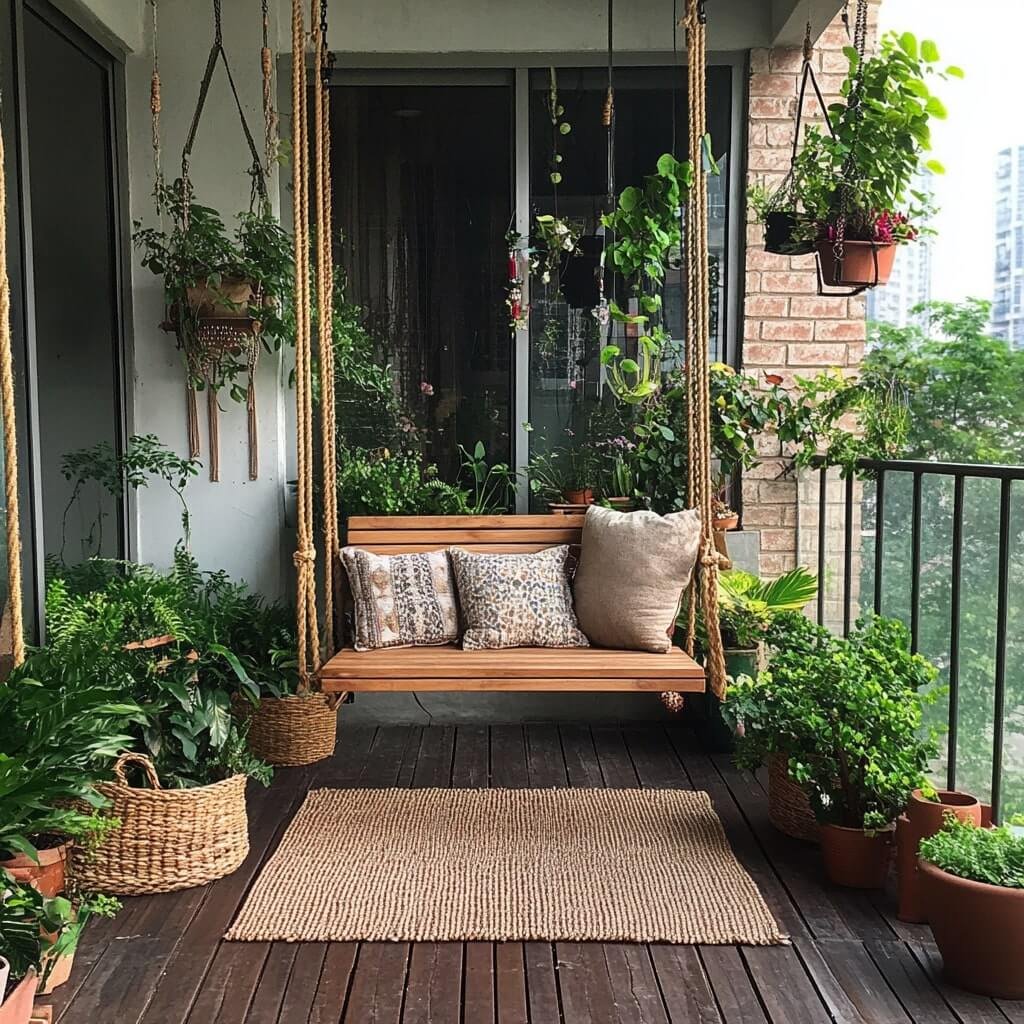
Fabric grow bags and lightweight resin containers do most of the heavy lifting here, no pun particularly intended. They hold roughly the same planting volume as ceramic or concrete equivalents while weighing a fraction as much, even once soaked through. Mixing perlite or vermiculite into your potting mix also reduces overall soil density without hurting root health, which matters more the higher up you are.
And smaller, more numerous pots spread across the floor are almost always structurally safer than fewer large ones clustered together, even when the total soil volume ends up roughly the same.
We’ve written before on small balcony garden online about which materials hold up best in different climates, which pairs well with this conversation since the lightest container isn’t always the most durable one, and there’s a real trade-off to weigh depending on where you live.
A Quick Word on Building Rules
Weight limits aren’t only a physics question. Many buildings have their own written restrictions on balcony use, sometimes stricter than the structural rating itself, sometimes just about what’s visible from the street. Checking your lease or asking property management directly takes ten minutes and avoids a genuinely awkward conversation later, or worse, an actual safety issue nobody caught in time.
If your building is older, or you’ve noticed any visible cracking, rust on support brackets, or water staining near the balcony’s connection to the building, that’s not a container gardening question anymore. That’s a maintenance request, and it should happen before any new planters go up, not after.
Container gardening on a balcony works best when the numbers are boring and settled early, leaving all the actual creative decisions, what to plant, how to arrange it, for the part that’s actually fun.
FAQs
How do I find out my balcony’s actual weight limit? Check your building’s structural documentation, lease agreement, or ask property management directly. Many residential balconies fall in the 40 to 60 pound per square foot range, but this varies enough by building that a direct answer from management is worth getting rather than assuming.
Is it safer to use fewer large pots or more small ones? Generally, several smaller pots spread across the balcony floor put less concentrated stress on any single area than the same total soil volume in one or two large containers. Distribution matters as much as total weight.
Does rainwater affect balcony weight even if I’m not actively watering? Yes, and this is easy to overlook. Rain saturates soil the same way manual watering does, and if drainage holes get blocked by debris or roots, water can pool inside a container and add significant unplanned weight.
Can I put a raised bed on my balcony instead of individual pots? Raised beds concentrate a lot of weight in one footprint, often more than people expect once filled with soil and watered. If you want one, check load capacity carefully first and consider placing it against the wall rather than centered on the floor.
Do balcony weight limits include the people standing on it? Yes. The rated live load capacity covers everything on the surface at once, people, furniture, and plants combined, not planters in isolation. That’s part of why the margin matters more than it might seem.
If you want to go deeper into the engineering side of this, the Growing Green Guide produced by the City of Melbourne has a genuinely useful breakdown of load calculations for rooftop and balcony gardens.