My basil snapped in half three summers ago. Not bent, not wilted. Snapped, clean across the stem, on a Tuesday when I wasn’t even home to see it happen. I came back to a pot full of soil and one sad, broken plant lying across my railing like it had given up.
That’s the moment I stopped treating my balcony like a mini backyard and started treating it like what it actually is: an elevated, exposed, wind-funneled growing space with its own rules.
If your balcony catches wind off a street corner, sits above the tenth floor, or just seems to turn into a wind tunnel every afternoon around 3pm, you already know the frustration. You plant something that should thrive in containers, and within a week it’s shredded, toppled, or just refusing to grow past six inches because it’s spending all its energy holding on rather than growing up.
1. Why Wind Wrecks Herbs Faster Than People Expect
Wind doesn’t just knock plants over. That’s the visible damage, the one everyone notices. The bigger problem is invisible: wind pulls moisture out of leaves faster than roots can replace it, which means your herbs are essentially dehydrating even when the soil is damp. Add in the physical stress of constant movement, and a lot of energy that should go toward growth goes toward simply not breaking.
Soft-leaved, water-hungry herbs take the worst of it. Basil, cilantro, and parsley all have broad, tender leaves with a lot of surface area, which is exactly what wind exploits. Herbs with small, narrow, or waxy leaves lose far less moisture and flex instead of tearing. This is the same principle behind why coastal shrubs tend to have tiny leaves. It’s not aesthetics, it’s survival. According to horticulture educators at the University of Illinois Extension, drought-tolerant herbs consistently outperform tender ones in exposed container settings, and that same drought tolerance tends to overlap heavily with wind tolerance.
If you haven’t actually measured how exposed your space is, it’s worth doing before you buy a single seedling. I wrote a full walkthrough on figuring out whether your balcony counts as genuinely windy, because “it gets breezy sometimes” and “gusts strong enough to tip a 10-inch pot” are two very different growing environments.
2. The Herbs That Actually Hold Up
Here’s where people usually go wrong: they assume wind tolerance and sun tolerance are the same thing, and they’re not. Rosemary, for instance, loves full sun and handles wind beautifully. Basil loves full sun and falls apart in a stiff breeze. You have to check both.
These are the herbs I’ve grown successfully, year after year, in a spot that regularly gets 20+ mph gusts:
| Herb | Wind Tolerance | Sun Needs | Notes |
|---|---|---|---|
| Rosemary | Excellent | Full sun | Woody stems, needle-like leaves, barely reacts to wind |
| Thyme | Excellent | Full sun | Low-growing habit means less leverage for gusts |
| Sage | Good | Full sun | Slightly floppy when young, sturdy once established |
| Oregano | Good | Full sun to part sun | Spreads low and wide, hard to knock over |
| Chives | Good | Full sun to part sun | Hollow stems bend without snapping |
| Lavender | Good | Full sun | Woody base develops real wind resistance after year one |
| Basil | Poor | Full sun | Broad leaves shred easily, needs a sheltered corner |
| Cilantro | Poor | Part sun | Thin stems, prone to toppling |
| Parsley | Fair | Part sun to full sun | Better than basil, still benefits from a windbreak |
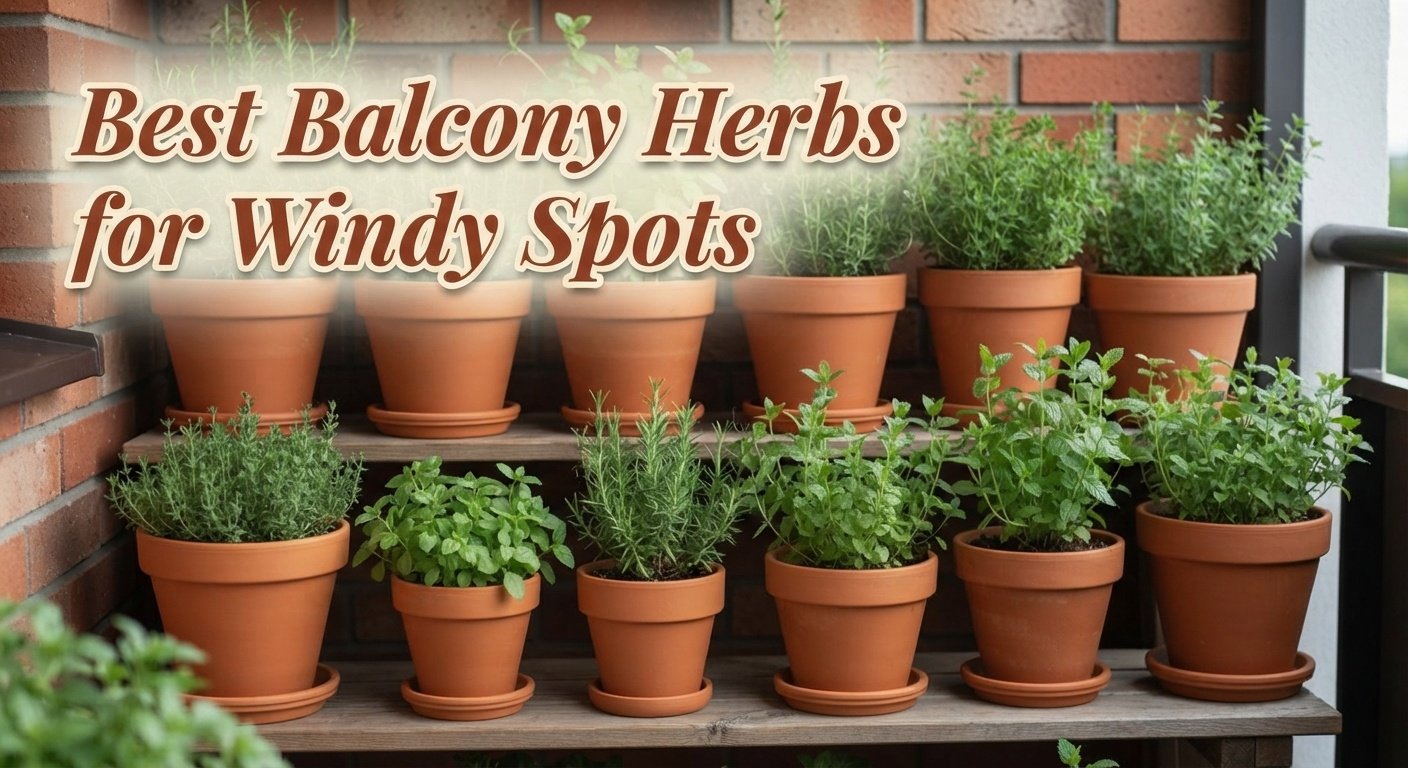
Rosemary and thyme are the two I’d tell anyone to start with. They’re Mediterranean natives, which means they evolved on hillsides that get hammered by wind constantly. Your balcony is basically a gentler version of what they’re already used to.
3. Setting Up Herbs So Wind Works With You, Not Against You
Container choice matters more here than in almost any other growing decision. A tall, narrow pot with a lightweight potting mix is a sail waiting to happen. Wide, low, heavy containers sit lower to the wind and have a lower center of gravity, so gusts have less to grab onto.
A few things that made a real difference for me:
- Group pots close together in a cluster rather than spacing them out. They act as windbreaks for each other.
- Skip the lightweight plastic pots for anything over a foot tall. Terracotta or ceramic adds weight exactly where you need it.
- Fill the bottom third of tall containers with gravel or broken pottery before adding soil, purely for ballast.
- Stake woody herbs like young rosemary in their first season, even if it feels unnecessary. It isn’t.
And this is something I got wrong for years: I kept buying bigger pots thinking size alone would solve the tipping problem. It doesn’t. A big pot with light, fluffy potting mix can still go over in a strong gust. Weight and shape matter more than volume. If you’re still working out the basics of container sizing for your space, this breakdown of why container size matters more than plant choice is worth reading before you commit to pots.
4. When You Actually Want Softer Herbs Anyway
Sometimes you just want basil. I get it, pesto season is not optional in my house. If your heart is set on wind-sensitive herbs, the answer isn’t to avoid them entirely, it’s to fake a sheltered microclimate.
A solid railing panel, a piece of clear acrylic zip-tied to the railing, or even a strategically placed taller plant can cut wind speed by 50 percent or more in the pocket right behind it. You’re not trying to eliminate airflow completely (plants still need some air movement to avoid fungal issues), just knock the edge off it.
This only works, though, if you already understand your light conditions on that balcony, because a windbreak can also cast shade you didn’t plan for. It’s worth cross-referencing against how much direct sun that spot actually gets before you install anything permanent. Small Balcony Garden has a guide on reading your balcony’s sun exposure that pairs well with this decision.
5. A Quick Note on Timing and Establishment
Young herb starts are far more vulnerable to wind than established ones. A six-week-old basil seedling with two sets of true leaves has almost no root mass to anchor it. I’ve had much better luck starting wind-sensitive herbs indoors or in a sheltered spot for the first three to four weeks, then transitioning them out once the stem has thickened and the root system has filled in.
Rosemary and thyme don’t need this babying nearly as much. You can often plant them straight into their windy final spot from a nursery pot without much drama, because they arrive already somewhat toughened.
For anyone just getting their footing with containers in general, not specifically the wind question, this starter guide to first pots covers the basics I’m assuming you already know in this piece.
There’s a version of this article I could write that tells you to just avoid growing herbs on a windy balcony altogether. I’m not going to write that one, because I’ve spent eight seasons proving it wrong. It just takes matching the plant to the actual conditions instead of the conditions you wish you had.
FAQs
Will a windbreak actually reduce how much I need to water? Yes, somewhat. Less wind means less moisture pulled from leaves and soil surface, so you may stretch watering by a day or so during peak summer. It won’t eliminate the need to check soil moisture regularly, especially in smaller pots.
Can I grow basil on a windy balcony at all, or should I just give up on it? You can, but plan on a sheltered corner, a windbreak, or a spot close to the building wall where turbulence is lowest. Corners near exterior walls are often calmer than the open railing edge.
Do wind-tolerant herbs still need staking when they’re mature? Usually not for rosemary, thyme, sage, or oregano once established. Lavender sometimes benefits from a single stake in its first year if the base hasn’t woodied up yet.
Is there a difference between wind damage and just underwatering? Yes, and it’s easy to confuse them. Wind damage tends to show up as tattered or torn leaf edges and a plant that looks stressed even right after watering. Underwatering shows more uniform wilting across the whole plant that improves within an hour of a good soak.
Should I bring container herbs inside during a particularly windy forecast? For a one-off storm warning, yes, if the containers are small enough to move easily. For your regular day-to-day wind exposure, it’s better to set the garden up to handle it long-term rather than moving pots constantly.
If you want a broader look at how wind interacts with container gardening beyond just herbs, Ask Extension has a solid Q&A thread on which plants tend to struggle versus hold up in exposed containers.