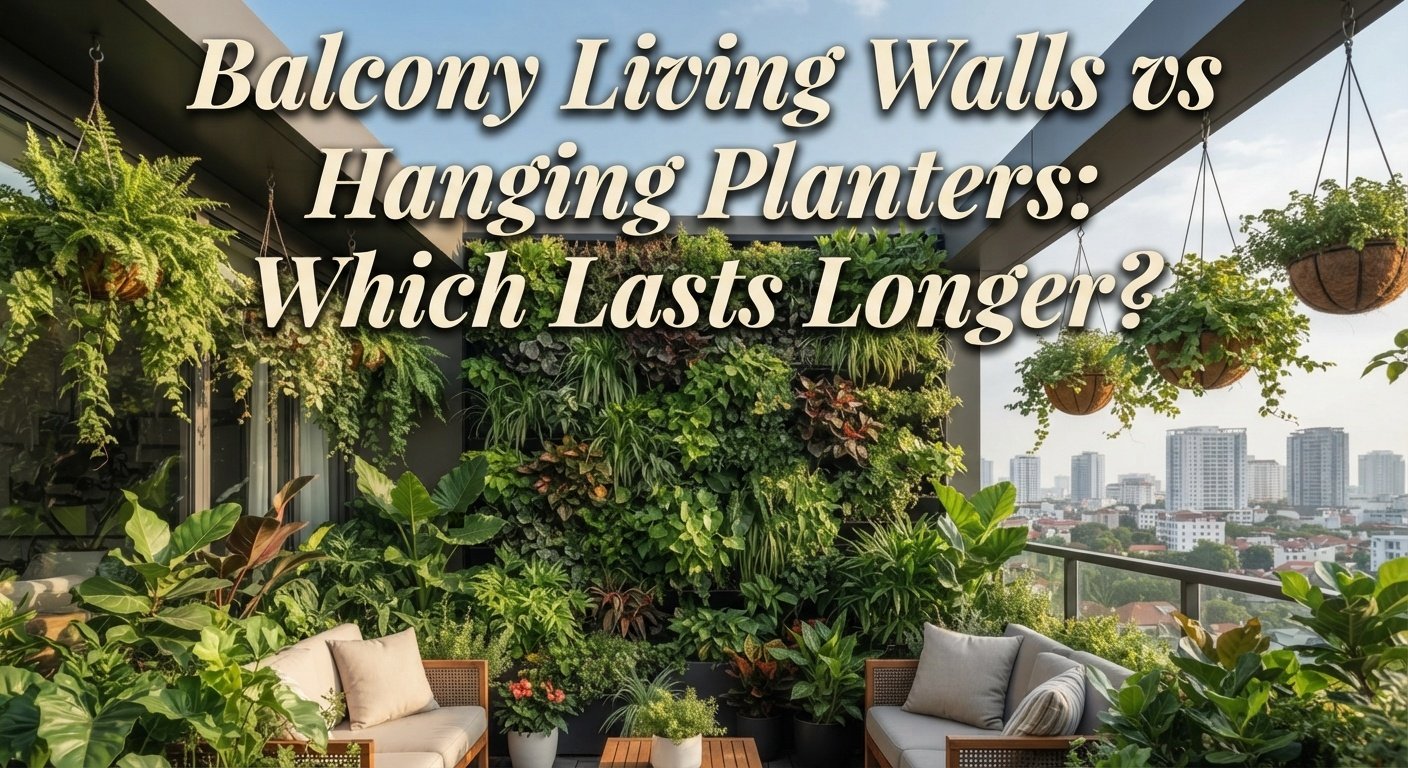
A living wall looks incredible in the photo. Dense, green, almost architectural, the kind of thing that makes a small balcony feel like it belongs in a design magazine. Hanging planters look almost plain by comparison. A few pots on hooks, some trailing stems, nothing dramatic. But six months in, one of these setups is usually still thriving and the other is often patchy, half-replaced, or quietly abandoned. Which one survives depends less on how they look on day one and more on what they demand from you every week after that.
Here’s how they actually compare once the novelty wears off.
1. What Each System Is Really Asking of You
A living wall is a planting system built into a vertical panel, usually a felt pocket structure, modular plastic grid, or a frame with integrated planting cells. Water and nutrients need to reach every pocket evenly, which almost always means some form of irrigation, even a basic gravity-fed drip line. That’s the trade you’re making for the density and the coverage. You get a wall of green, but you also get a system with more points that can fail.
Hanging planters are simpler by design. Each pot is its own unit, with its own soil volume, its own drainage, and its own watering needs. Nothing is interdependent. If one plant struggles or dies, you swap it out and the rest of the display is unaffected. That independence is the whole appeal, and it’s also why hanging setups tend to last longer with less specialized attention.
2. Watering Is Where Living Walls Usually Fail First
Most living wall failures we hear about trace back to water distribution, not plant choice. The pockets at the top of a panel dry out faster because gravity pulls moisture down and out before the top rows get their share. Meanwhile the bottom rows can stay soggy, especially if drainage wasn’t planned carefully during install. You end up babying two very different microclimates on the same six-foot panel.
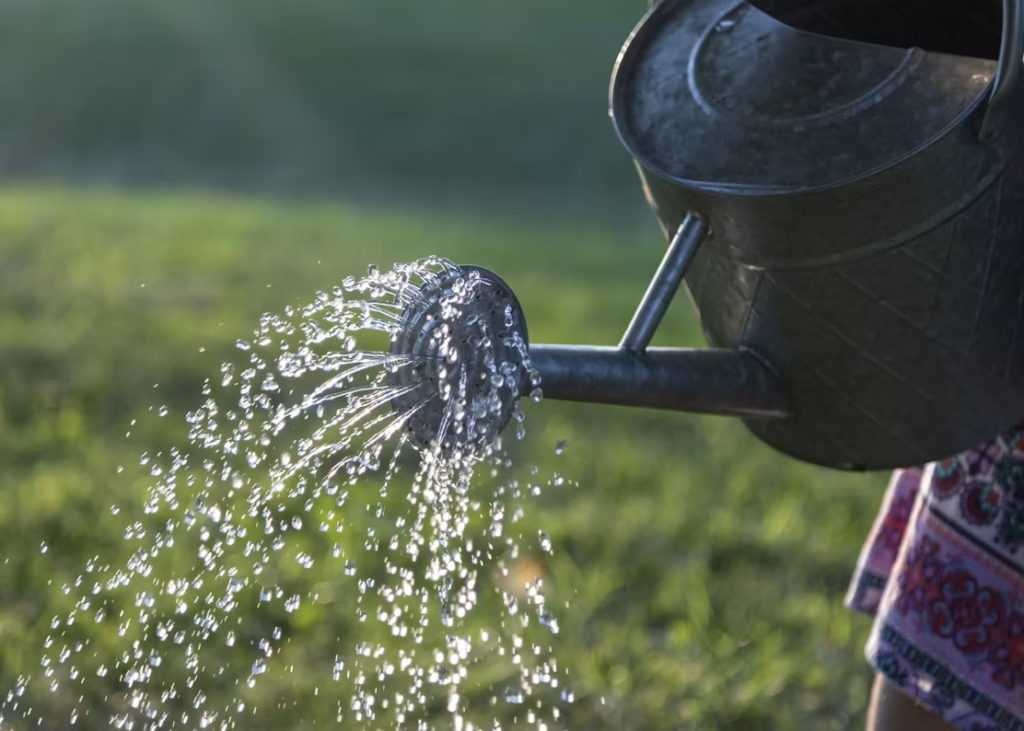
Hanging planters don’t have this problem in the same way, but they introduce their own version of it. Because each pot has a relatively small soil volume, and because they’re often hung in more exposed positions to catch light, they dry out fast. This isn’t unique to hanging setups, we’ve covered the general mechanics of it in why balcony pots dry out faster, but hanging position makes the wind exposure worse than a floor-level pot would face. A hanging basket at shoulder height on a balcony rail catches more airflow than the same pot sitting on the ground.
So the honest comparison isn’t “which one needs less water.” It’s which failure mode you’d rather manage. Living walls need consistent, even distribution across a fixed structure. Hanging planters need frequent, individual attention because they’re small and exposed. Neither is low maintenance. They’re different kinds of maintenance.
| Factor | Living Wall | Hanging Planters |
|---|---|---|
| Watering method | Usually irrigation-dependent | Manual, pot by pot |
| Failure pattern | Uneven moisture across panel | Fast drying due to exposure |
| Repair if a section fails | Often requires replacing multiple cells | Swap one pot |
| Typical lifespan with basic care | 1 to 2 years before major refresh | 2 to 4 years with rotating replacements |
| Setup cost | Higher, especially with irrigation | Lower, scales with number of pots |
| Weight on balcony structure | Significant, needs checking | Distributed, generally lighter |
3. Weight Is the Quiet Deciding Factor
This is the part people skip past because it’s not visually interesting, but it should probably be the first question, not the last. A saturated living wall panel, soil, irrigation hardware, and mature plant growth included, can weigh considerably more per square foot than most people estimate before install. On a balcony with a defined weight limit, and most rental balconies have one whether it’s posted or not, that matters enormously.
Hanging planters distribute weight differently. You’re adding load at specific hook points rather than across a continuous vertical section, and the total mass involved is usually far less than an equivalent-sized living wall. If you haven’t actually worked out what your balcony can safely hold, it’s worth doing that math before falling in love with either option. We walk through the process in calculating your balcony’s weight load, and it takes less time than most people expect.
This is also where a lot of new balcony gardeners get it backwards. They assume the visual scale of a living wall means more planning is required for aesthetics, and treat the structural question as an afterthought. It should be the opposite. Aesthetics can be adjusted after the fact. A balcony that can’t hold the weight can’t be adjusted after the fact, not without real risk.
4. Plant Selection Changes the Odds Significantly
Living walls tend to fail faster when they’re planted with species that want consistent moisture and even light, because a vertical panel rarely delivers either evenly. Ferns and mosses often struggle on panels facing full sun. Succulents often rot in the lower, wetter pockets. The plants that hold up best in living walls tend to be tougher, more drought-tolerant species that can handle uneven watering without sulking, things like certain sedums, heucheras, or low creeping herbs depending on your light conditions.
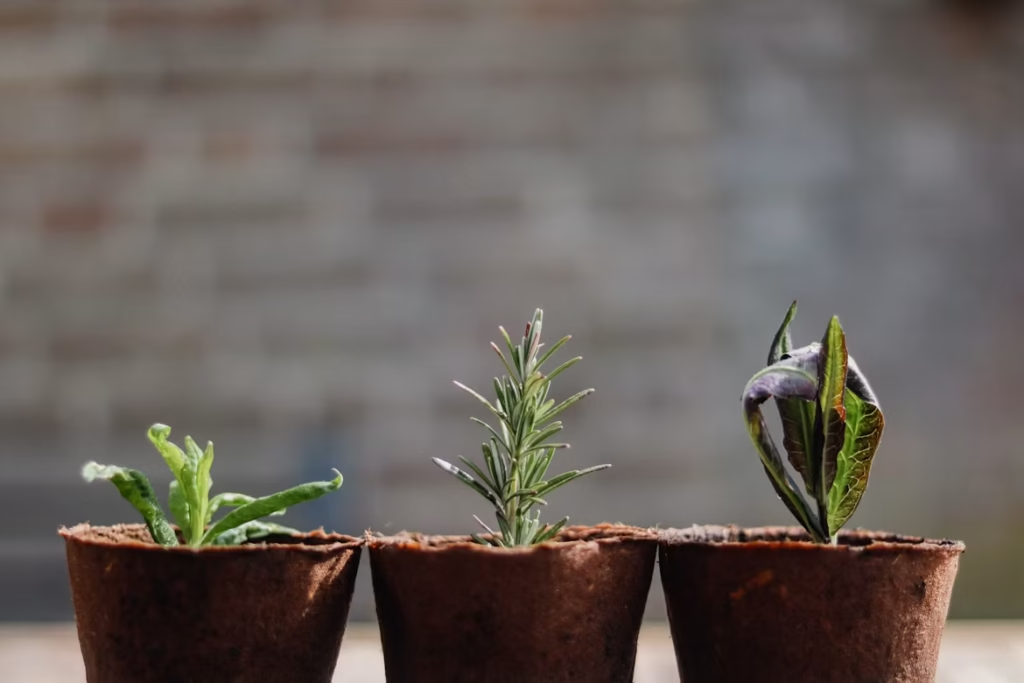
Hanging planters give you more flexibility because each pot is its own microclimate you can tailor individually. A trailing pothos in a shadier hanging spot, a cascading petunia in a sunnier one, that kind of mixing is much easier to manage than trying to zone a single connected panel for different needs. If you’re still working out what your particular balcony can support before committing to either system, reading your balcony’s sun before planting is worth doing first, since both systems live or die by getting that assessment right upfront.
Wind matters here too, more for hanging planters than for wall systems. A hanging pot swings and gets buffeted in ways a flush-mounted panel doesn’t, and that constant movement stresses stems and accelerates soil drying. If your balcony sees regular wind, best balcony herbs for windy spots has some species suggestions that tolerate movement better than most.
5. What Actually Determines Longevity
Neither system is inherently more durable. What determines longevity is whether the maintenance pattern matches how much attention you’re realistically going to give it. A living wall with proper irrigation, checked and adjusted seasonally, can genuinely last for years and improve as plants fill in. But it needs that irrigation checked. Left on autopilot with no seasonal adjustment, most living walls decline within a year, usually starting with the driest section going patchy first, then spreading as gaps let more light and wind hit the remaining plants.
Hanging planters last longer on average mostly because the failure is contained. One dead plant doesn’t threaten the rest. That containment is underrated. It’s not that hanging planters are inherently hardier, it’s that a single point of failure in a hanging arrangement costs you one pot, while a single point of failure in a living wall system, a clogged emitter or an underperforming irrigation zone, can cascade across an entire section of the panel before you notice.
If you’re deciding between the two and your balcony gets checked on irregularly, maybe you travel a fair amount or just don’t want a demanding routine, hanging planters are the safer long-term bet. If you’re home consistently and willing to treat the irrigation system as something that needs regular attention, not a set-it-and-forget-it install, a living wall can genuinely outperform expectations.
Most of the small balcony garden setups we’ve seen fail early weren’t badly designed. They were designed for a version of the owner’s attention span that didn’t match reality. Pick the system that fits how you actually garden, not how you’d like to imagine yourself gardening.
FAQs
Can I do a hybrid, part living wall and part hanging planters? Yes, and it often works well. Use the wall for tougher, drought-tolerant plants near the top or sunnier sections, and hang more delicate or trailing plants where you can monitor and water them individually. This also spreads the structural weight instead of concentrating it in one panel.
Do living walls need professional installation? Not always, but the irrigation component is where most DIY installs go wrong. A basic modular panel with hand watering can work on a small scale, but anything larger than a couple of square feet benefits from at least a simple gravity-fed drip system, which is easier to get right with some guidance the first time.
Will a living wall damage my balcony wall or railing? It can, if moisture isn’t managed properly. Panels mounted directly against a wall without an air gap or backing layer can trap dampness against the surface over time. Always leave a small gap and check behind the panel periodically, especially in humid climates.
How many hanging planters can a standard balcony railing hold? This depends entirely on your railing’s rated weight capacity and the hook hardware you’re using, not just how many will physically fit. Check the manufacturer specs on your hooks and don’t assume a railing built for decorative use can handle sustained planter weight through wind and rain.
Is one option better for renters who can’t drill into walls? Hanging planters are generally the easier route for renters, since railing-mounted hooks and clip systems don’t require permanent fixtures. Most living wall panels need some form of wall or structural mounting, which is harder to undo cleanly at move-out.
More on getting the structural basics right before you commit to either setup is over at smallbalconygarden.online.